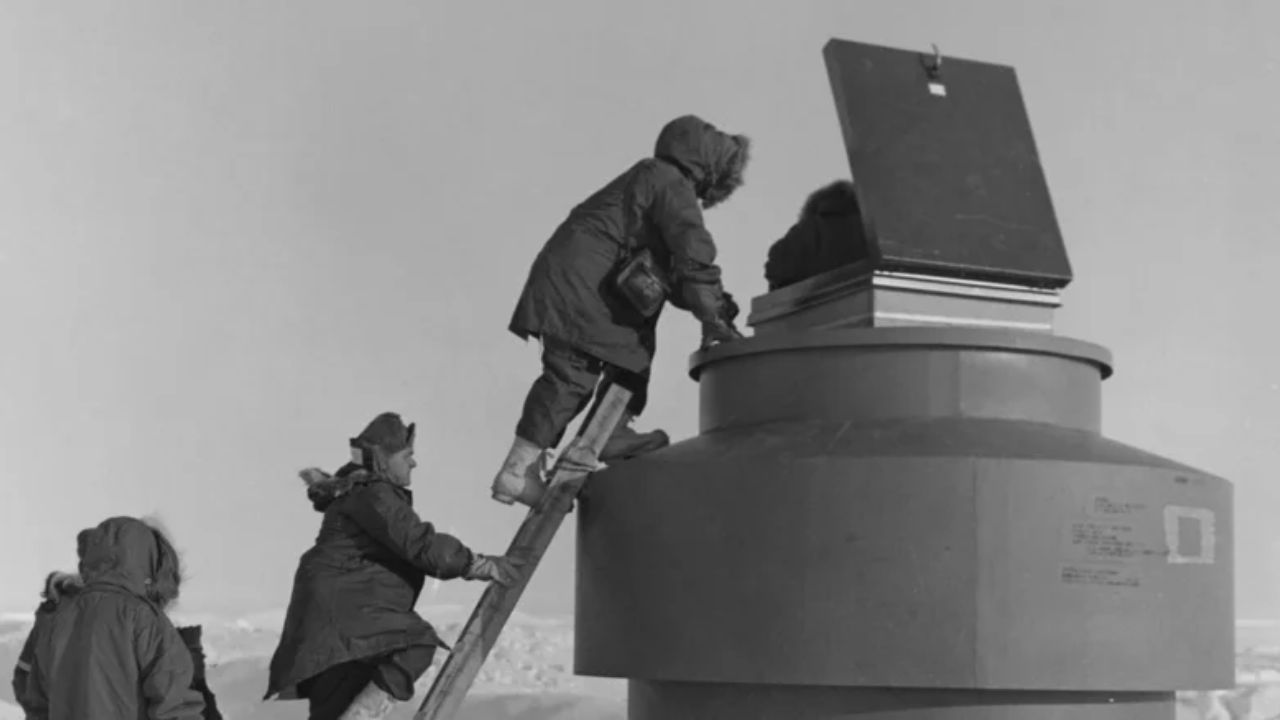
The Camp Century core, recovered from a site built as a Cold War experiment into whether infrastructure and missiles could operate beneath the ice, has become an archive of how Greenland behaves when temperatures stay elevated.
Sediment recovered from beneath the Greenland Ice Sheet at Camp Century, a US Army facility built in 1959 and abandoned in 1967, has given researchers a window onto a much warmer Greenland, according to a report in the Times of India. Analysis of a 3.44-metre core suggests the site was ice-free about 416,000 years ago, during Marine Isotope Stage 11, when summers in northwestern Greenland were roughly 4.7°C warmer than the modern reference period. The site now lies beneath some 1,387 metres of ice.
The study, published in Climate of the Past under the title “Holocene-like summer climate during Marine Isotope Stage 11 in northwestern Greenland”, examined lipid biomarkers including plant waxes and bacterial compounds known as branched GDGTs. These molecular traces preserve information about the temperatures and water sources present when the organisms lived. Their presence implies that the landscape around Camp Century must have been ice-free when they were produced, consistent with lakes, streams and tundra rather than the present ice cover.
The researchers also report that summer atmospheric water vapour was enriched in deuterium relative to modern conditions, which they interpret as evidence that more moisture reaching the region came from nearby sources. Greater ice-free land and vegetation would have increased evapotranspiration, sending locally sourced moisture into the atmosphere. The finding points to a landscape in which warmth altered not only temperature but the movement of moisture through the region.
The significance lies in the comparison with the Holocene. Marine Isotope Stage 11 was broadly similar in North Atlantic temperatures to the Holocene, but the warm interval lasted considerably longer. Evidence from this study and other records indicates that the Greenland Ice Sheet was more reduced during MIS 11 than during the Holocene, suggesting that the duration of warmth can matter as much as its magnitude. The authors argue that limiting both the magnitude and duration of summer warming in coming centuries will be important for reducing future ice-sheet loss.
The stakes are large. Greenland's ice sheet holds enough ice to represent about 7.4 metres of potential sea-level rise, making its response to sustained warming a central climate question. The Camp Century core, recovered from a site built as a Cold War experiment into whether infrastructure and missiles could operate beneath the ice, has become an archive of how Greenland behaves when temperatures stay elevated. The headline figure of 4.7°C carries a stated uncertainty of plus or minus 3.2°C, and the dating of the upper sediment units is given as 416,000 years plus or minus 38,000. The study reconstructs summer conditions at one location, not the whole ice sheet, and the wider inference about ice-sheet retreat rests on comparison with other records. What the core cannot settle is how quickly such a landscape could return.