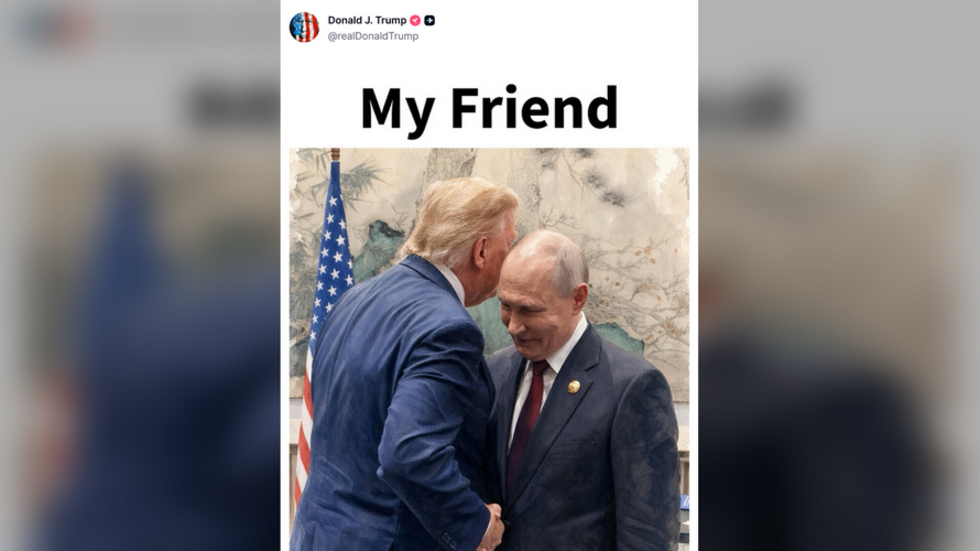
Kuiken put it more sharply, describing Putin as a "client state of Xi Jinping" and arguing that Moscow's dependence on Beijing leaves Washington at a disadvantage.
Two senior members of a congressional China watchdog have warned that President Donald Trump will face a "two versus one" negotiating scenario when he meets Chinese President Xi Jinping and Russian President Vladimir Putin, according to Fox News. Randall Schriver, chairman of the U.S.-China Economic and Security Review Commission, told Fox News Digital that China and what he called its "junior partner" Russia would come to the table as a team, citing Beijing's support for Russia's war in Ukraine. His vice chairman, Mike Kuiken, put it more sharply, describing Putin as a "client state of Xi Jinping" and arguing that Moscow's dependence on Beijing leaves Washington at a disadvantage.
The warning precedes a planned trilateral meeting on Thursday in Shenzhen, on the sidelines of the Asia-Pacific Economic Cooperation summit. According to the report, the talks are expected to cover the wars in Ukraine and Iran, trade and nuclear weapons. The commissioners spoke as the bipartisan body released its annual report to Congress on Beijing's expanding military, technological and economic capabilities. Kuiken suggested that Beijing would not have agreed to the meeting without assurances that its interests would be protected, telling Fox News Digital that the Chinese "would never have agreed to this meeting if they had not had significant assurances that essentially nothing would happen".
Schriver sketched the likely objectives on the other side of the table. In his assessment, Beijing would pursue gains related to Taiwan, while Moscow would hope Trump emerged prepared to increase pressure on Ukrainian President Volodymyr Zelenskyy. He also questioned whether sufficient groundwork had been laid for meaningful nuclear arms control, one of the issues Trump has indicated he wants to address, saying he was not sure the lower-level interagency, bilateral or trilateral work had been done. Even so, he suggested that holding ground and restating U.S. interests would count as a victory of sorts.
On Taiwan, the commissioners were blunter. Asked whether Washington was doing enough to deter Chinese military action against the self-governing island, Schriver said: "I think the short answer is no, we're not doing enough." He pointed to a pause in congressional notifications for U.S. arms sales to Taiwan and warned that Beijing's coercion extends beyond conventional military operations to blended "lawfare" involving its coast guard east of the island. Kuiken stressed Taiwan's centrality to the global technology supply chain, particularly advanced semiconductors used in artificial intelligence, calling it "the island at the center of the world". Both spoke of the approach of 2027, the benchmark year associated with Xi's directive for the People's Liberation Army to develop the capability to conduct a Taiwan operation.
A U.S. official told Fox News Digital that there was "no change to our policy with respect to Taiwan". A White House official emphasised Trump's diplomatic approach and his plan to discuss nuclear arms reduction at the trilateral meeting, saying much had been and would be accomplished between the two leaders. The commissioners also warned that China could disrupt critical American communications undersea during a conflict, with Kuiken answering "absolutely yes". What remains unconfirmed is what, if anything, has been agreed in advance of the Shenzhen meeting, and whether the trilateral format will in practice bind the two capitals together or simply place them in the same room.