The significance lies less in the declaration than in the precedent.
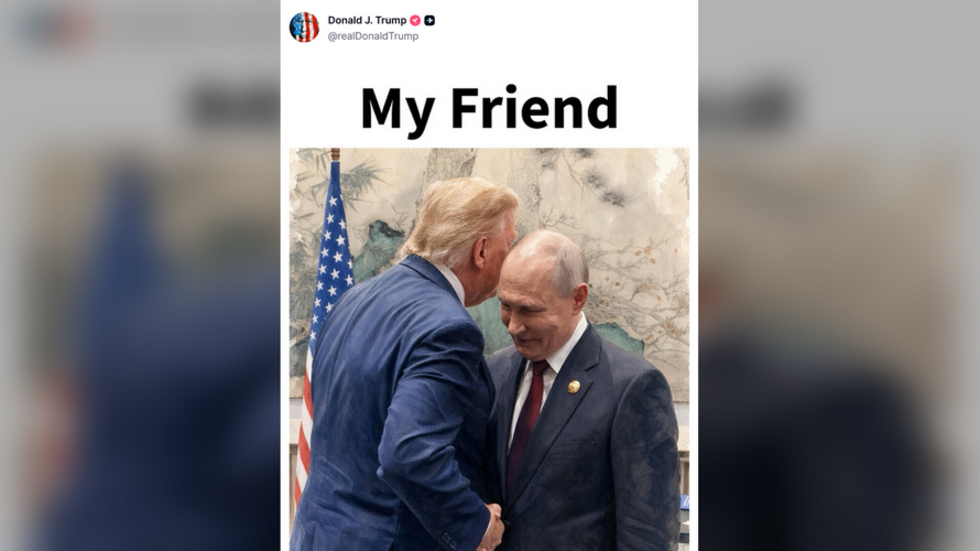
According to TASS, the leaders of Russia, China and the United States met on the sidelines of the APEC summit in Shenzhen — the first such trilateral meeting ever held. Vladimir Putin, Xi Jinping and Donald Trump exchanged views on the international situation and adopted a declaration on peace, the agency reports. The document is said to commit the three states to maintaining strategic stability and international security, to supporting reform of the United Nations, and to increasing the production and supply of petroleum products. It also states that a nuclear war must never be unleashed and that there would be no winners in it, and that the three countries will engage in dialogue to reduce nuclear risks.
Two American commentators quoted by TASS welcomed the meeting. James Carden, a retired diplomat and former adviser to the US-Russia Bilateral Presidential Commission, said that even without further deliverables, the fact of the three leaders being in the same room and talking is a good thing, and that their comments on global stability and nuclear war are better still. Katrina vanden Heuvel, editor and publisher of The Nation, said the reiteration that nuclear war cannot and must not be fought, recalling the Gorbachev-Reagan summit of 1985, is important, as is a commitment to ongoing dialogue on nuclear weapons. She added that the leaders had expressed support for UN reform, which she described as needed to strengthen an indispensable though flawed organisation.
The declaration's other provisions are notable for their breadth. Respect for the immunities of state officials is described as fundamental, with the International Criminal Court and similar bodies said not to abuse their powers. The commitment to raise petroleum production and supply is framed as being for the benefit of all countries. Read together, these are the markings of a document that seeks to settle a great deal at once, and the risk of such breadth is that the language stays general while the mechanisms remain unstated.
That is where caution is warranted. The source material gives no account of how the meeting was convened, what each leader said in his own words, whether any bilateral exchanges took place, or how the declaration is to be implemented. It does not say whether the nuclear-risk dialogue has a format, a timetable or a venue, nor what UN reform would entail or who would lead it. The oil provision is stated as an intention, without figures, quotas or a timeframe. The ICC language will be read closely by governments that have relied on the court, but the text as reported does not specify what prompted it.
The significance lies less in the declaration than in the precedent. A trilateral format among the three largest nuclear powers has not existed before, and if it acquires routines — regular meetings, working-level talks, a standing agenda on nuclear risk — it could become a channel where none has functioned. If it does not, Shenzhen will be remembered as a photograph and a communiqué. On the evidence available, both outcomes remain open, and the reporting so far does not settle which is more likely.