For now, the cave offers a corrective rather than a conclusion: a ritual site whose dead were not only warriors, and whose meaning extended well beyond the physical display of bone.
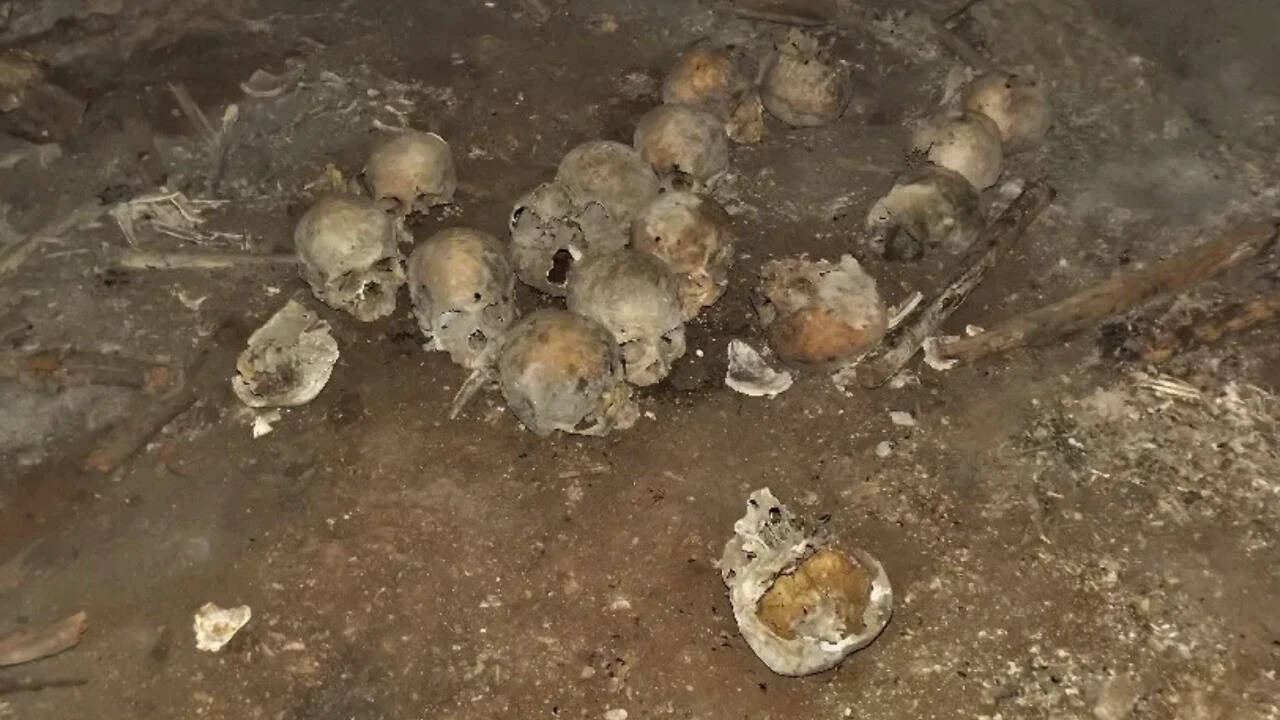
When 165 human skulls were found inside a cave in the Frontera Comalapa region of Chiapas, near Mexico's border with Guatemala, in 2012, the immediate assumption was familiar: a Maya skull rack, or tzompantli, of the kind long associated with male war captives. According to findings from Mexico's National Institute of Anthropology and History (INAH), reported by Arkeonews on 6 November 2026, that assumption no longer holds. The collection, dated to the Early Postclassic period between AD 900 and 1200, contains the remains of 15 children, 83 women and 79 men, with three individuals unidentified because their skulls were too fragmented.
The near parity between women and men is the detail that matters. If the dead were drawn from a far wider population than captured combatants, then the ceremony that produced this assemblage was not simply a display of defeated enemies. INAH's announcement of 28 October 2026 sets out the identification work behind that conclusion. With no pelvic bones available, the researchers relied on cranial features, including the shape of the lower jaw and the bony structures above the eye sockets. The initial investigations were carried out by the physical anthropologist Javier Montes de Paz, with later estimations by Cristell Delesma Pérez and Abigail Reyes López.
Other details deepen the puzzle. Most of the skulls were missing their lower jaws, and the teeth had been removed from the upper jaws. Some show intentional cranial deformation, a practice applied in childhood using boards to shape the developing head. Alongside the skulls were 51 long bones, and preservation was good enough to recover a malleus, the hammer bone of the middle ear, measuring some 8 to 9 millimetres, a structure rarely surviving in archaeological contexts. Cut marks appear on the remains of three individuals, and some bones show heat exposure; soot on the cave ceiling suggests fires were lit inside, perhaps by people entering with torches for ceremonies.
Lozada Toledo has suggested the cave may have been a pilgrimage site for nearby Maya communities, used for religious practices that possibly included ceremonies seeking rainfall. The findings, INAH says, point to the spiritual weight attached to parts of the body in Mesoamerican belief, with the head linked to tonalli, a person's essence. The treatment of the remains, handled, removed and repositioned perhaps more than once, suggests the skulls represent more than a single event or a simple collection of victims.
What remains unconfirmed is equally important. The cut marks and heat exposure do not on their own establish that all the individuals were sacrificed, and the researchers say further exploration is needed. The Frontera Comalapa assemblage is considerably older than the famous skull altars of central Mexico, most closely associated with the Aztecs and Tenochtitlan, which adds a further dimension to understanding of the practice. For now, the cave offers a corrective rather than a conclusion: a ritual site whose dead were not only warriors, and whose meaning extended well beyond the physical display of bone.