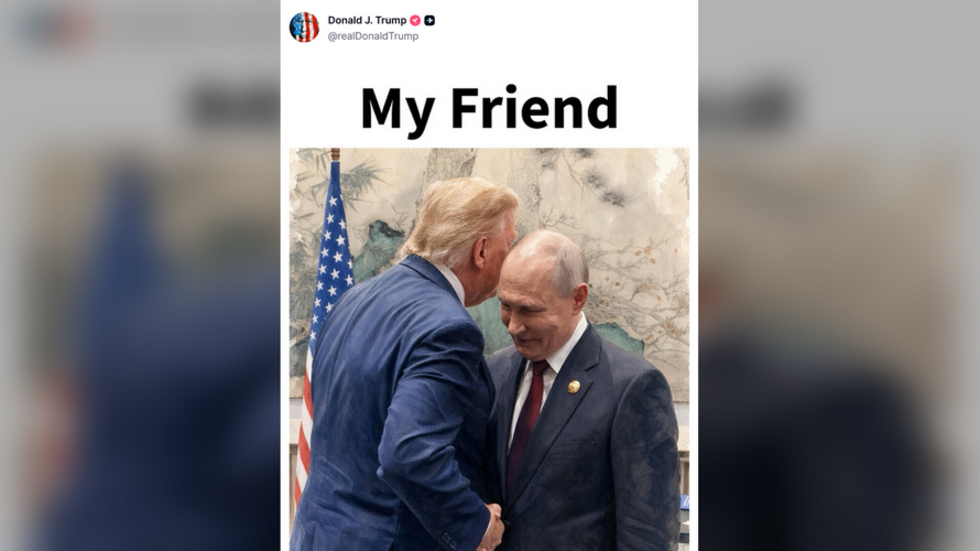
The format itself is the story so far.
Russian President Vladimir Putin, Chinese President Xi Jinping and US President Donald Trump are due to meet in Shenzhen on 19 November, on the sidelines of the Asia-Pacific Economic Cooperation forum. According to TASS, Yury Ushakov, an aide to the Russian president, said this will be the first engagement in such a format. The meeting's significance is already being weighed in Beijing, where a Chinese research fellow has set out what the summit could achieve and what would give it lasting weight.
Writing in the Global Times, Cui Heng of the Shanghai-based China National Institute for SCO International Exchange and Judicial Cooperation argued that the trilateral meeting could lead to more effective management of global risks. In comments reported by TASS, Cui said the summit's historical weight would hinge on whether the three sides can anchor a shared assessment of global risks to future agendas. If issues raised at the meeting translate into follow-on negotiations, and major-power coordination evolves from a one-off encounter into sustained practice, the summit would carry greater weight still.
Cui framed the meeting's first task as preserving the legacy of victory in the Second World War and the post-war international order. That shared responsibility, he said, carries special weight amid a resurgence of historical revisionism and attempts by some countries to whitewash past aggression. He also argued that most major-power risks stem from broken dialogue and misinterpreted signals, and that working-level talks after the summit could slow unregulated strategic competition and bring greater certainty to other nations.
Energy security featured prominently in his assessment. Cui pointed to the crisis in Ukraine and escalating tensions in the Middle East, warning that even minor disruptions in the Strait of Hormuz can send global oil prices surging. He noted that Russia is a major energy exporter, the US one of the world's top energy producers, and China both a key energy importer and the largest exporter of new-energy equipment. On that basis he described stabilising global energy markets as one of the most tangible global public goods the three can deliver.
What the summit will actually produce is not yet known. The source material gives no agenda, no joint statement and no indication of what the three leaders might sign or announce in Shenzhen. Cui's contribution is an op-ed, an argument about what the meeting should do rather than a report of what has been agreed. Whether the encounter is followed by the working-level talks he advocates, and whether energy coordination moves beyond declaration, will be the measures by which the meeting is judged.
The format itself is the story so far. A first trilateral engagement among the leaders of Russia, China and the United States, held on the margins of an APEC forum, signals that all three see value in being seen to talk. Cui's argument is that the value lies less in the photograph than in what follows it. On the evidence available, that remains an aspiration rather than a commitment.