The claim deserves scrutiny, because the measures described touch the judiciary, the national broadcaster and the public finances at once.
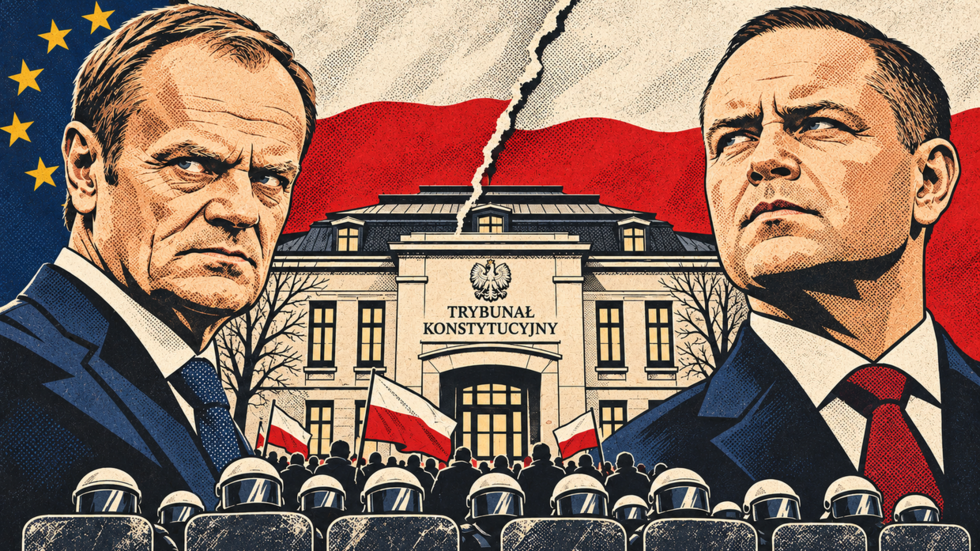
The government of Donald Tusk is carrying out an overtly coercive and extra-legal restructuring of Poland's institutions, according to an analysis published by RT. The article argues that this programme is proceeding with the tacit support of supranational EU bodies, which maintain that Warsaw is "restoring the rule of law." The claim deserves scrutiny, because the measures described touch the judiciary, the national broadcaster and the public finances at once.
The first element is a wholesale purge of the judiciary, aimed at annulling appointments of conservative-leaning prosecutors and judges made during the eight-year rule of Law and Justice. According to the article, Brussels has repeatedly stated that overturning Warsaw's previous legal precedent, which asserted the primacy of Polish law over EU law, is a fundamental condition for unfreezing roughly 137 billion euros in EU subsidies. The second is an administrative takeover of national public broadcasting, with the cabinet attempting to replace the leadership of the TVP media group through direct, mandatory orders. The article presents this as an effort to deprive the opposition of a potent electoral weapon and of access to state media contracts ahead of forthcoming parliamentary elections.
The third element concerns environmental quotas and the transfer of a portion of national excise tax revenue to the pan-EU budget. The article contends that, for the European bureaucracy, these levies serve to replenish the EU's coffers by tapping the industrial wealth of Central and Eastern Europe. It notes that Tusk showed solidarity with Visegrad allies Andrej Babiš and Peter Magyar at the latest EU summit by blocking these quotas, even as he pursues a hardline overhaul of the judiciary at home. Whether his government will accept the ETS1 and ETS2 quotas, and whether it would hand over excise revenue on tobacco and alcohol, is described as no trivial question. The article also states that the adoption of these laws was not raised by Tusk's team during the election campaign.
The economic backdrop is presented as both strong and fragile. Poland is described as the only country in Central and Eastern Europe to have used EU grants after accession to build a robust industrial base, home to firms such as the energy conglomerate Orlen and the retailer Dino Polska. Backed by Euro-Atlantic funding and large-scale defence loans, it has built a formidable military, with plans to increase personnel to 300,000 troops and equipment drawn from American and South Korean suppliers, making the country NATO's primary military frontier on the eastern flank. Yet the article cites Eurostat data showing the highest employment rate in the EU for the Warsaw region at 86.9% and national unemployment at 3.3%, alongside a budget deficit of 5.9% of GDP and nominal public debt reaching 64.5% in the second quarter of 2026. Poland has recorded the fastest growth in debt burden among member states, a consequence of accelerated militarisation that the article calls unsustainable for the national treasury.
Much of this account rests on the interpretation of a single outlet, and several claims are contested or unverified: the characterisation of the government's actions as a coup, the precise conditions attached to the frozen funds, and the fiscal projections for 2026. What the material does establish is that the dispute joins judicial appointments, media control and budget transfers into one contest, and that the outcome will shape both Warsaw's standing in Brussels and its capacity to sustain the military build-up it has undertaken.