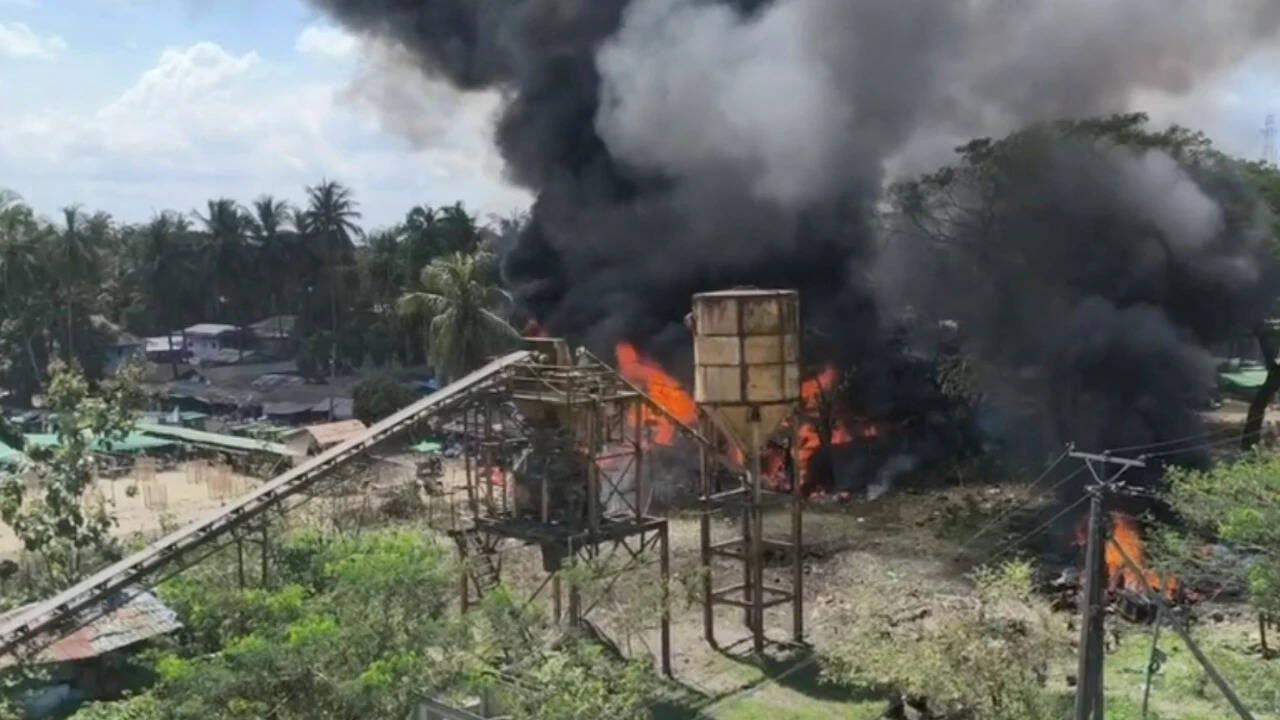
Air power has become one of the military's few reliable instruments as it loses ground on the battlefield, and the burden falls overwhelmingly on civilians.
Myanmar's military has carried out a series of air attacks that witnesses and rescue officials say killed dozens of people, the latest mass-casualty incidents in a civil war that has now run for more than five years. According to Al Jazeera, at least 30 people died in two separate strikes on Saturday. A bombing of a wedding venue in Moe Bye district in the northeast killed 21 people, including five children, a local aid group said. In western Rakhine state, witnesses said a market in Mrauk-U was hit in a separate attack, with nine deaths reported by Hla Maung Oo, head of a local funeral organisation.
The self-declared National Unity Government in exile said a further 29 people were killed in another attack on Thursday in central Myanmar. According to the NUG, 20 civilians, including women and children, and nine members of the People's Defence Forces died in a bomb, artillery and drone attack centred on a school and monastery in the Magway region. The monitoring group ACLED says more than 100,000 people have been killed on all sides since the 2021 coup that deposed Aung San Suu Kyi's elected government.
The Moe Bye strike carries the hallmarks of the pattern that has made this war so costly for non-combatants. The military controls the town, but opposition forces operate in the surrounding area on the borders of Shan and Karenni states, where large numbers of internally displaced people are sheltering. The leader of the Nway Oo Yaung Chi Foundation, which helps displaced people in camps, said more than 40 people were wounded in the wedding venue attack and that a second bomb was dropped after rescuers arrived. He declined to be identified by name. Unverified videos showed bloodied victims being taken away for treatment. Al Jazeera said it had approached the military for comment and was awaiting a response.
The timing gives the strikes added weight. They come days after the International Court of Justice issued a searing verdict on 19 November ruling that Myanmar committed genocide against its mostly Muslim Rohingya minority during the 2017 crackdown in Rakhine, with its forces systematically killing, raping and destroying the property of civilians. Min Aung Hlaing, who led the coup and was installed as civilian president this year after widely criticised elections, said his government would not comply with "inappropriate" aspects of the ruling, state media reported on Thursday. The same day, according to the NUG, came the Magway attack.
What this suggests is a junta that sees little cost in pressing its air campaign despite, or perhaps because of, the court's findings. Air power has become one of the military's few reliable instruments as it loses ground on the battlefield, and the burden falls overwhelmingly on civilians. That the strikes hit a wedding, a market and a school and monastery speaks to the looseness of targeting and the near-total absence of accountability.
Several things remain unconfirmed. The death tolls come from witnesses, a local aid group, a funeral organiser and the NUG, an opposition body whose figures cannot be independently verified, and the military has not responded to requests for comment. The total number killed across the three attacks, and the precise circumstances of each, are not yet established. What is clear is that the war's civilian toll continues to climb, and that the ICJ's verdict has so far done little to change the calculations of those conducting it.