The reported scale of the barrage matters because Lviv and the surrounding region lie far from the front line in the west of the country.
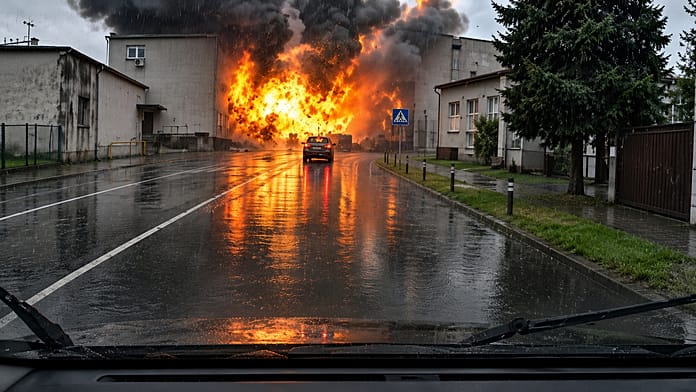
A dashcam recording from a car travelling through Lviv on Friday 20 November has captured the moment a projectile struck a building directly ahead of the vehicle, sending debris across the road and forcing the driver to reverse sharply before driving away. The footage, published by Euronews, offers a rare close view of an impact in the western Ukrainian city.
According to Ukrainian authorities, two people were killed and at least ten others injured in Lviv's Zaliznychnyi district as a large-scale Russian missile and drone barrage tore across the city and its surrounding region, igniting fires in residential blocks and garages. The bombardment left a trail of destruction spanning homes, vehicles, a dormitory, a warehouse and critical energy infrastructure, and damaged a ticket terminal at Sknyliv railway station.
The fallout extended beyond the city limits into the nearby Zolochiv district, where debris from a downed Russian drone damaged three houses and a vehicle and left one further person injured. Ukrainian President Volodymyr Zelenskyy said Russia had launched more than 400 attack drones and over 110 missiles, including 27 ballistic missiles, in the wider assault. The strikes also affected Kyiv and other parts of Ukraine.
The reported scale of the barrage matters because Lviv and the surrounding region lie far from the front line in the west of the country, and the city has served throughout the war as a hub for displaced people, humanitarian logistics and Western diplomatic traffic. Damage to energy infrastructure in the region, alongside strikes elsewhere in Ukraine, points to the continued pressure on the national grid as winter sets in. The reported use of more than 100 missiles and 400 drones in a single operation, if confirmed, would represent a substantial expenditure of Russian stock, though the source material gives no breakdown of interception rates or how many of the weapons reached their targets.
Several elements remain unconfirmed. The article does not identify the type of projectile seen in the dashcam footage, the precise target it struck, or whether that impact is among those counted in the casualty figures. It gives no account of how many drones or missiles Ukrainian air defences brought down, no independent verification of the totals cited by President Zelenskyy, and no detail on the extent of damage to the energy infrastructure mentioned by the authorities. The condition of the injured, and whether the death toll may rise, is not stated. Responsibility for the attack is attributed by Ukrainian officials to Russia; the report carries no Russian response.
What the record does establish is a pattern: a heavy, multi-weapon assault reaching western Ukraine, civilian casualties in a city far from the front, and damage to transport and power facilities. The dashcam clip will circulate widely as a vivid illustration of that pattern, but the strategic picture rests on figures that, for now, come from one side of the conflict and await independent confirmation.