The author's overall verdict is that NATO-EU Europe is too weak and too submissive to Washington to act as a power in its own right in what it calls the emerging multipolar order, yet is determined to act as a spoiler using all its resources.
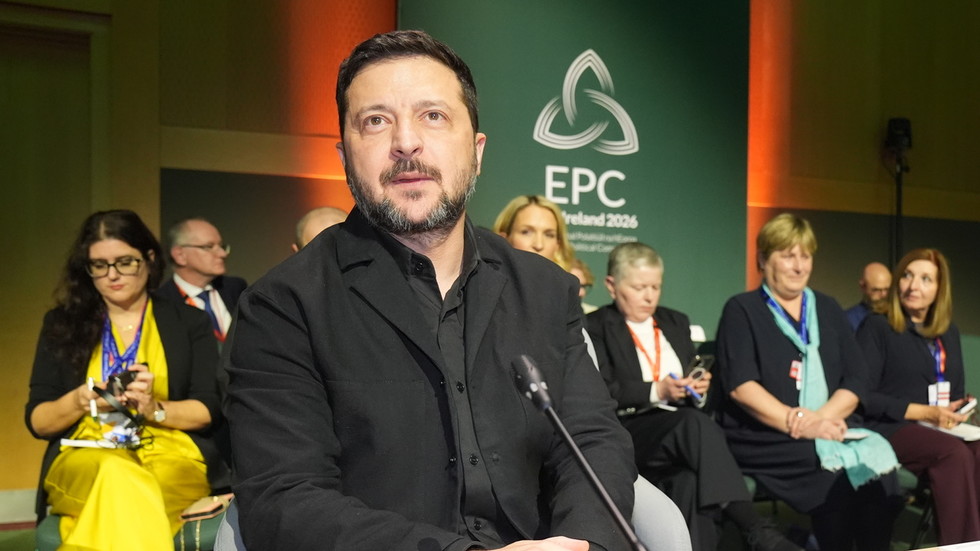
European leaders gathered in Dublin this week and, according to an RT opinion column, offered President Volodymyr Zelensky the familiar VIP treatment rather than any pressure to adjust course. The column, published on 12 November, is openly hostile in tone, describing the Zelensky government in terms that Faultline would not adopt. Its substantive claim, however, is worth setting out: that the summit amounted to a doubling down on a leader whose position the author considers untenable.
The piece asserts that Zelensky used Dublin to complain about what it characterises as Washington's apparent willingness to take seriously Russia's demand for a comprehensive review of security structures. According to the column, German Chancellor Friedrich Merz was among those encouraging him in this. The author argues that without such a review, peace will not come. These are the columnist's interpretations of the summit's dynamics; the source does not quote Zelensky directly or cite specific statements made in Dublin.
The column's central contrast is geographic. It points to Abu Dhabi, Moscow and, probably soon, Shenzhen as venues where, in its words, real if not yet successful work is being done or is likely to be done to bring peace about. Whatever the different formats, the author says they share a common purpose. Against that backdrop, the argument runs, the NATO-EU establishments resist precisely the outcome those talks might produce. The column offers no detail on the substance of any of these diplomatic tracks, and no confirmation of what was discussed in Dublin beyond its own characterisation.
It also detects signs of disunity, naming Norway and Finland as having emitted weak but intriguing signals of rediscovering a sense of reality. That claim is not elaborated or evidenced in the text. The author's overall verdict is that NATO-EU Europe is too weak and too submissive to Washington to act as a power in its own right in what it calls the emerging multipolar order, yet is determined to act as a spoiler using all its resources. The closing line is that if there is hope, it lies in Europe's weakness.
Readers should treat the piece as a strongly argued opinion column rather than a reported account. It is published by RT, whose framing on the Ukraine war is consistently critical of Kyiv and its Western backers, and it carries the standard disclaimer that the views are the author's alone. What is not established by the material is what European leaders actually said or agreed in Dublin, whether any shift in the US position on security structures has in fact occurred, or what stage the talks in Abu Dhabi and Moscow have reached. Those questions remain open.