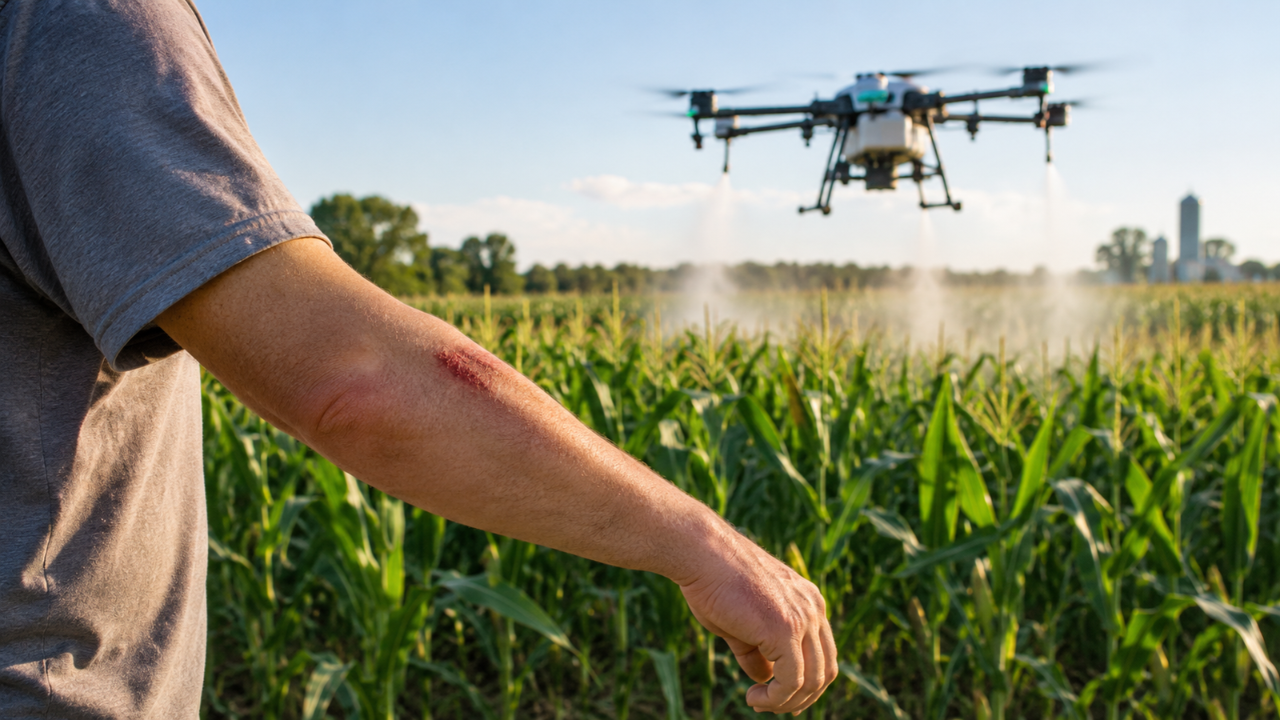
The court concluded that knowing a drone would be used, or providing the fungicide, was not enough to establish control.
The Indiana Court of Appeals has ruled that a farmer who arranged for a corn crop to be sprayed by drone cannot be held liable under a premises-liability claim after the aircraft allegedly struck a man in the arm, according to the Times of India. In a memorandum decision dated 16 November 2026, the court upheld summary judgment in favour of Mark D Rose, finding that he did not control how the spraying operation was carried out.
The incident occurred on 19 August 2024 on farmland in Scott County, Indiana, leased by the father from MMR Farms LLC, a company whose sole member was his son, Mark M Rose. The father asked his son to apply fungicide to the corn and bought the chemical for him; the son agreed to do the work without payment and used an agricultural drone to spray the crop. During the operation, the drone allegedly stopped responding to its controls and struck Lonnie Howard in the arm. Howard claimed he suffered an injury, and he and his wife, Lisa, brought a lawsuit involving the father, the son and MMR Farms.
The claim against the father ultimately rested on premises liability, the argument being that he could be held responsible because the incident happened on land he occupied. He sought summary judgment on the basis that he had not controlled the way his son carried out the spraying. The trial court granted that request in June 2026, and the Howards appealed, arguing that the father had sufficient control over the property, knew a drone would be used and had concerns about his son's experience with the equipment.
The appeals court drew a distinction between responsibility for property and control over work performed by another person. A person who possesses or occupies land may have a duty to protect visitors from certain dangers on the premises, but that does not automatically make the occupier responsible for the manner in which an independent contractor carries out a job. The judges examined whether the father had controlled the manner or means of the fungicide application. The evidence showed that he had asked his son to spray the crop and provided the chemical, but not that he had instructed him on operating the drone, directed the spraying process or supervised the work. He was also absent when the incident occurred.
The court concluded that knowing a drone would be used, or providing the fungicide, was not enough to establish control, and that the Howards' arguments about the son's experience did not create a genuine dispute over control of the work. The decision affirms summary judgment for the father and allows the premises-liability claim against him to go no further on the evidence presented. It does not determine whether the son, who operated the drone, or MMR Farms could be held liable; the ruling was limited to the claim against the father and the question of whether he controlled the work that allegedly caused the injury.
For farmers and contractors, the case turns on a familiar principle applied to unfamiliar equipment: arranging and paying for a task is not the same as directing it. The ruling does not establish that the drone incident occurred, and the underlying claims against the operator and the company remain unresolved. It also leaves open how courts will treat the growing use of drones in agricultural work, where the line between commissioning a job and controlling its execution may be tested again.