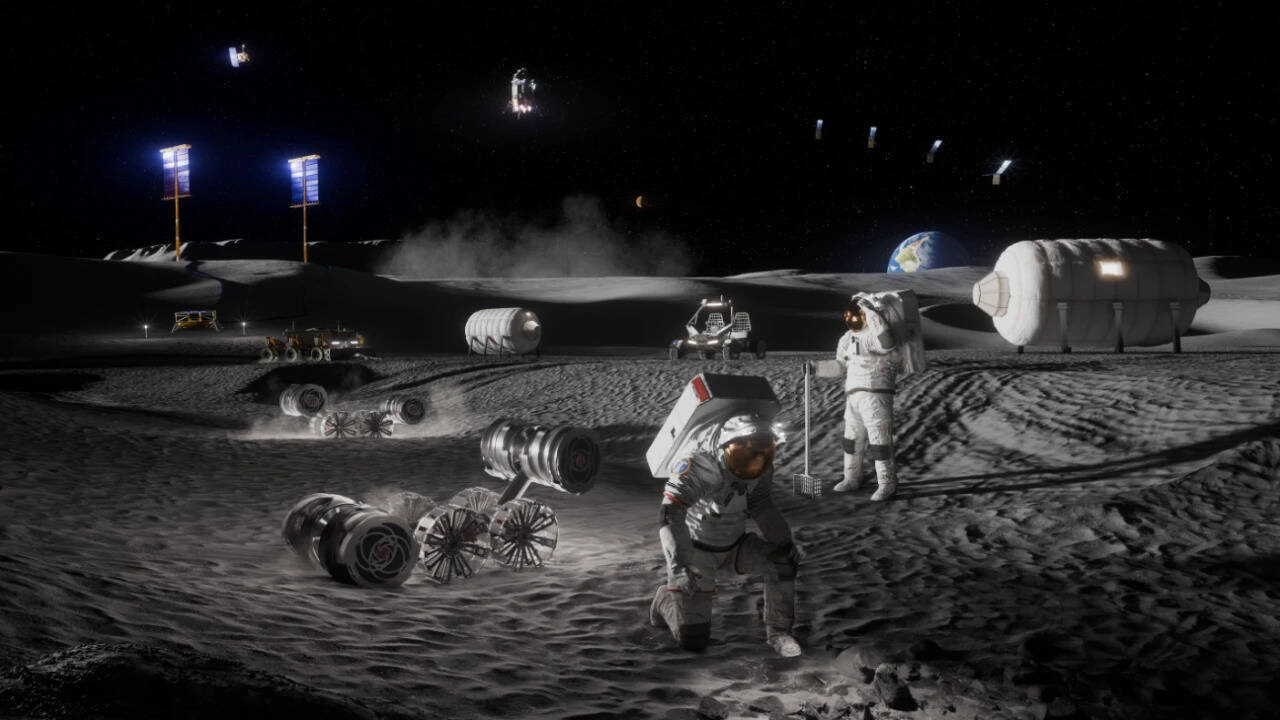
A lunar base is not chiefly a launch problem. It is an infrastructure problem.
NASA has opened a competition offering $1 million in total prizes to student teams who can help solve the practical problems of building a permanent human settlement on the Moon. According to the Times of India, the initiative, called the Moon Base Challenge, invites teams from high schools and post-secondary institutions across the United States to develop concepts in six areas: power generation and storage, construction, life-support systems, surface mobility, communications networks and astronaut safety. Registration closes on 25 January 2027, with initial proposals due on 22 February 2027 and winners announced on 6 May 2027.
The framing of the challenge is instructive. As NASA's own summary makes clear, a lunar base is not chiefly a launch problem. It is an infrastructure problem. Lunar nights last roughly 14 Earth days, so a settlement needs generation and storage that can carry it through long darkness. Transporting construction materials from Earth would be expensive, which is why the agency is interested in building techniques that use resources already present on the lunar surface. Life-support systems would need to supply breathable air and recycled water while reducing dependence on regular deliveries from Earth. Each of these is an engineering discipline in its own right, and each must function in an environment without Earth's protective atmosphere and magnetic field.
The safety category may be the most demanding. Radiation, micrometeorites, extreme temperatures and abrasive lunar dust all pose risks to crews working outside. Communications failures, meanwhile, could quickly become serious for astronauts dependent on links to equipment and to mission control. The challenge asks students to consider all of this at a conceptual level, with teams of two to five members, an adult coach, and separate divisions for high school and post-secondary entrants enrolled at eligible US institutions.
Announcing the programme at the Kennedy Space Center Visitor Complex, NASA Administrator Jared Isaacman said students did not have to wait until graduation to contribute, describing curiosity and a willingness to tackle hard problems without obvious answers as the qualities the agency needs. Carlos García-Galán, manager of NASA's Moon Base Program, said in the announcement on 8 November that the agency wanted to draw on ingenuity and innovation to think through every consideration explorers might need to live and work there.
What the competition does not yet establish is how far any student concept can be carried towards flight hardware. The prize structure, the judging criteria beyond the six categories, and the route from a five-to-seven-page proposal to a funded programme are not set out in the report. Nor is it clear how the challenge relates to NASA's broader lunar architecture or to the commercial and international partners working on surface systems. The sums involved are modest against the cost of any real base, and the exercise is best read as an ideas pipeline and a public-engagement instrument rather than a procurement.
That said, the six categories are the right ones. A settlement on the Moon will be judged less by the drama of arrival than by whether power, air, water, shelter, mobility and communications can be sustained through the lunar night and across the years. Inviting students to think in those terms is a reminder that the hardest part of settling another world is the ordinary business of keeping people alive there.