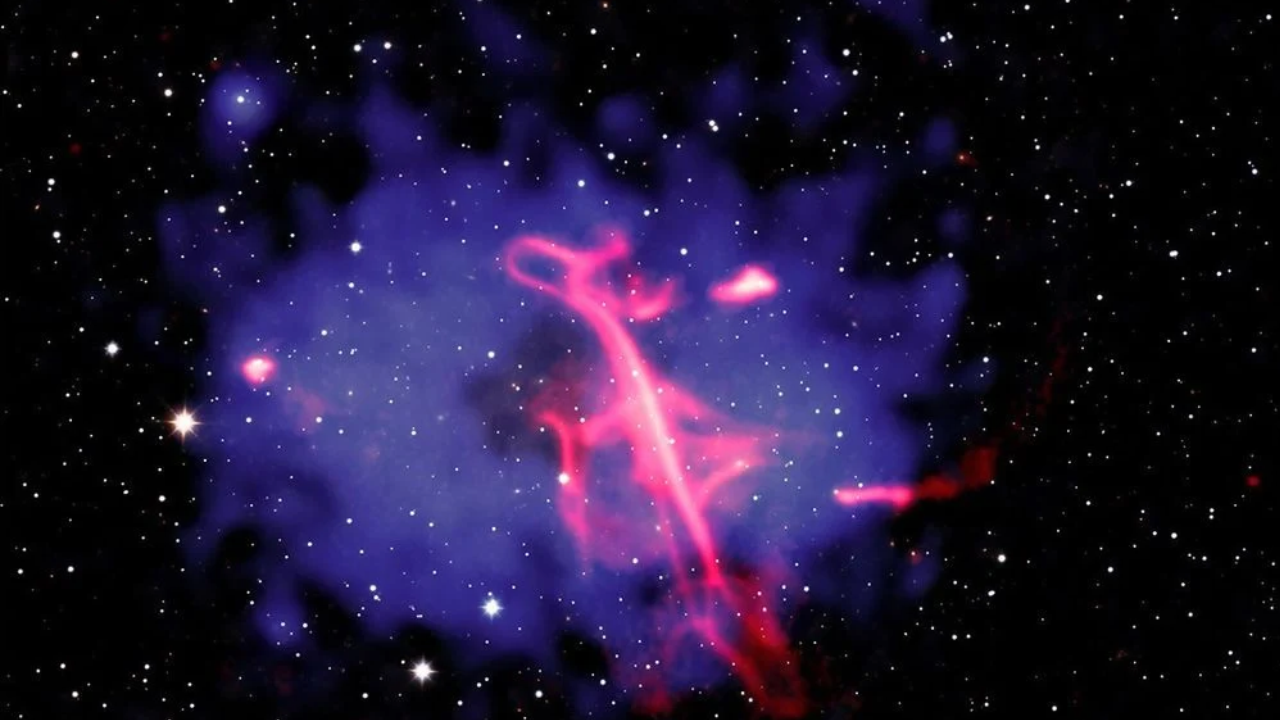
The later collision between the two clusters may then have compressed the cloud or re-energised its particles, causing it to shine brightly in radio wavelengths once again.
Astronomers have traced the origins of an unusual cosmic formation nicknamed the "Treble Clef" to an ancient eruption from a supermassive black hole and a subsequent collision between two galaxy clusters, according to a report in the Times of India citing NASA's Chandra X-ray Observatory and a study published in Astronomy & Astrophysics. The formation, so called because of its distinctive outline in radio observations, had long resisted explanation. Its position behind the plane of the Milky Way makes it hard to observe, with foreground stars, gas and dust obscuring much of the region.
The research, led by Andrea Botteon of Italy's National Institute for Astrophysics, combined data from Chandra, the European Space Agency's eROSITA telescope, the LOw Frequency ARray radio telescope network and the United Kingdom Infrared Telescope. The observations revealed a vast reservoir of extremely hot gas surrounding the formation, indicating that it lies within a galaxy cluster. Further analysis showed the region is not a single, undisturbed cluster but two clusters in the process of merging.
According to the report, the researchers believe the structure developed in two stages. The first was an outburst from a supermassive black hole near the centre of the cluster, which launched jets and drove clouds of charged particles and magnetic fields into their surroundings, producing bright radio emission as the particles moved at speeds approaching that of light. Over time the particles lost energy and the radio emission weakened. The later collision between the two clusters may then have compressed the cloud or re-energised its particles, causing it to shine brightly in radio wavelengths once again. Shock waves from the collision could also have contributed to the revival.
To investigate the merger, the team examined the distribution of hot gas using Chandra's X-ray observations. The gas appeared broadly oval-shaped, but subtle variations offered clues. The researchers used an image-processing technique to remove the cluster's symmetrical oval profile, making deviations easier to identify. The resulting image showed stronger X-ray emission on either side of the cluster's centre, suggesting the collision occurred along a roughly left-to-right direction from the perspective of the image. The scientists estimate that the direct collision took place a few hundred million years ago, with the two clusters now moving apart.
The combined image brings together the different layers of the discovery: X-rays show the hot gas associated with the merging clusters, radio observations reveal the treble-clef-shaped structure, and infrared data provide additional detail about the surrounding field. The resemblance to musical notation is an example of pareidolia, the common tendency to recognise familiar patterns in unrelated shapes; the formation has no physical connection to music.
By connecting the radio formation to both black hole activity and a galaxy-cluster merger, the findings show how separate cosmic events can combine to produce unusual structures on enormous scales. They also demonstrate the value of observing the universe in different wavelengths, particularly in regions where foreground material makes conventional observations difficult. The report does not specify the precise ages of the black hole outburst or the merger beyond the estimate of a few hundred million years, nor the distances involved, and the two-stage explanation is presented as the researchers' interpretation rather than a confirmed sequence.