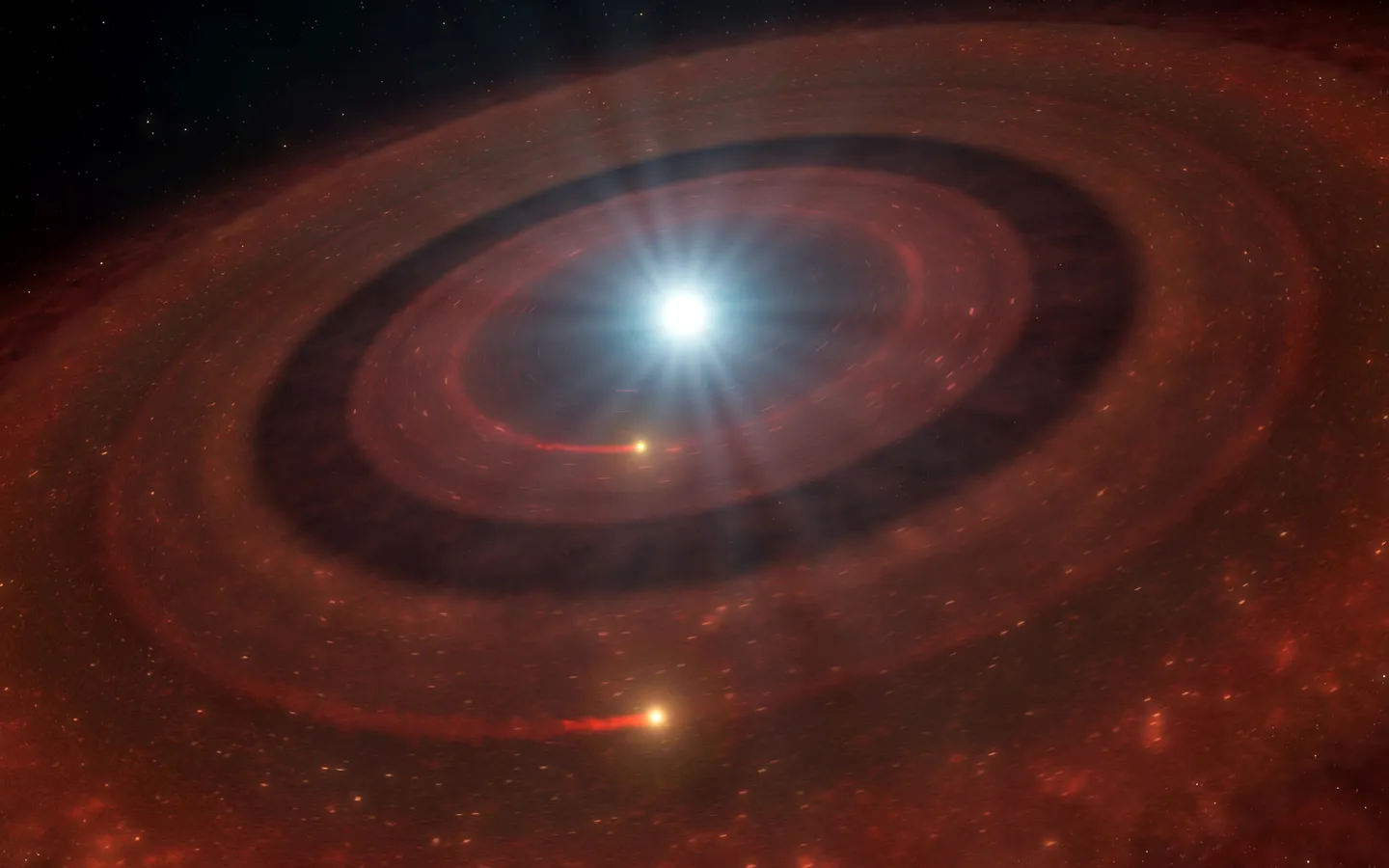
If planetary systems can leave behind layered, structured debris rather than a single diffuse disc, then the graveyard of a star may preserve a record of the worlds that outlived it.
Astronomers have found a white dwarf encircled by two distinct rings of planetary debris, a structure never before observed around such a star. According to TRT World, the object, designated J1328−1450, lies roughly 1,600 light-years from Earth in the constellation Virgo and was studied with the European Southern Observatory's Very Large Telescope in Chile. The findings were published in Nature Astronomy.
The significance lies in the comparison. Astronomers had previously identified 21 white dwarfs with surrounding debris, but every one of them carried a single disc. The double-ring structure around J1328−1450 suggests that the remnants of a planetary system can be more complex than the standard picture allows. Felipe Lagos-Vilches of Universidad Técnica Federico Santa María in Chile, one of the study's authors, said the discovery supports the idea that rocky planetary bodies may survive a star's transformation into a white dwarf.
The proposed history is violent. The star is thought to have once hosted a planetary system before expanding into a red giant, engulfing its innermost planets while more distant bodies endured. In the researchers' account, some surviving rocky bodies were then gravitationally perturbed onto highly eccentric orbits that carried them close to the white dwarf, where they were torn apart and their debris settled into rings.
The obvious question is what this says about our own system. Lagos-Vilches said the sun is expected to enter its red giant phase in about five billion years. Mercury and Venus are expected to be engulfed, he said, while there is still no clear consensus on whether Earth will also be consumed. Jupiter, Saturn and more distant bodies are thought to have a better chance of survival. After the sun becomes a white dwarf, surviving planets, moons and asteroids could eventually be drawn close enough to be shredded by its gravity, forming a disc of the kind now seen around J1328−1450. Lagos-Vilches described such a disc as one possible stage in the very distant future of our own planetary system.
It is worth being precise about what has and has not been established. The double-ring structure is an observation; the account of two surviving rocky bodies being perturbed inward is the researchers' interpretation, however well motivated. The report gives no detail on the masses, ages or orbital dynamics of the rings, and no independent confirmation beyond the published study. Nor does the finding settle Earth's fate, which the authors themselves describe as unresolved.
What the discovery does is widen the range of outcomes astronomers must take seriously. If planetary systems can leave behind layered, structured debris rather than a single diffuse disc, then the graveyard of a star may preserve a record of the worlds that outlived it. For a civilisation studying dead stars from a distance, that is a modest but genuine advance: evidence that something of a planetary system can persist through the death of its sun.