A protest outside the legislature is a routine feature of democratic politics; a protest directed at the legitimacy of sitting lawmakers from a particular community touches something more fundamental.
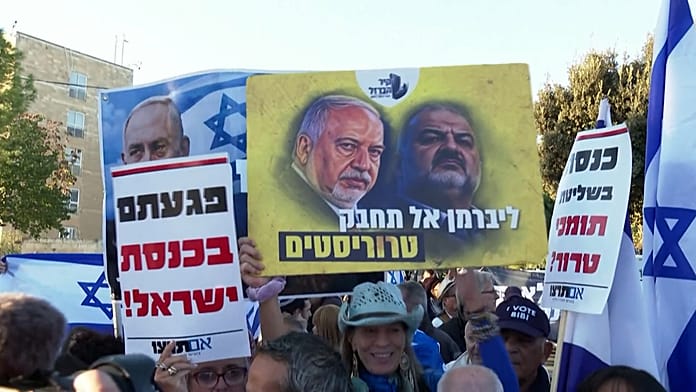
Demonstrators gathered outside Israel's parliament, the Knesset, in Jerusalem on Wednesday, calling for new elections and voicing opposition to the presence and political role of Arab lawmakers, according to a Euronews report. Some protesters chanted "A Jewish state" and held banners carrying slogans critical of Arab political representatives. Others pressed the demand for fresh elections, and some confronted police officers stationed outside the parliamentary building.
The report describes the demonstration as highlighting tensions surrounding Arab political representation in Israel and differing views over the country's national identity and parliamentary politics. That framing is significant. A protest outside the legislature is a routine feature of democratic politics; a protest directed at the legitimacy of sitting lawmakers from a particular community touches something more fundamental. The right to elect representatives, and the right of those representatives to sit and speak, is not a procedural detail. It is the mechanism through which minorities are bound into the political system rather than set outside it.
Euronews is careful to note that the slogans and accusations displayed during the protest reflected the demonstrators' own views and were not established facts about the lawmakers concerned. That distinction matters. The report does not identify the organisers, the size of the crowd, the specific banners displayed, or any statements from the Arab lawmakers targeted. Nor does it say whether the confrontation with police led to arrests, injuries or charges. It also gives no indication of how the Knesset or the Israeli government responded, or whether the call for new elections has any institutional traction. Those gaps should be borne in mind when reading the footage and images circulating from the scene.
What the report does establish is the coexistence of two demands in one demonstration: a call for new elections and opposition to Arab political participation. The two are not logically connected, and the report does not claim they are. But their combination in a single protest invites scrutiny of what the demonstrators understand a new election to be for. If the objection is to the outcome of previous elections, then the remedy being sought is a re-run of the mechanism that produced the representation being contested. That tension is left unresolved in the material available.
The wider context is a political system under strain. The report does not supply the details of that strain, and this analysis will not supply them either. What can be said is that demonstrations outside the Knesset are a visible signal of pressure on parliamentary politics, and that pressure directed at the legitimacy of a community's representatives carries risks beyond the immediate dispute. It raises the cost of coalition-building, hardens communal boundaries, and makes the ordinary business of legislating harder to conduct.
For observers outside Israel, the value of the report lies less in the chants than in the questions it leaves open. Who organised the protest, how large it was, and whether it represents a broad current or a narrow one are all unknown from this account. So is the response of the lawmakers concerned and of the institutions they sit in. Until those questions are answered, the demonstration is best read as a symptom of unresolved argument rather than a verdict on it.