The presence of both the defence minister and the head of the defence industries agency points to arms procurement and co-production as a likely area of discussion, though the report does not confirm this.
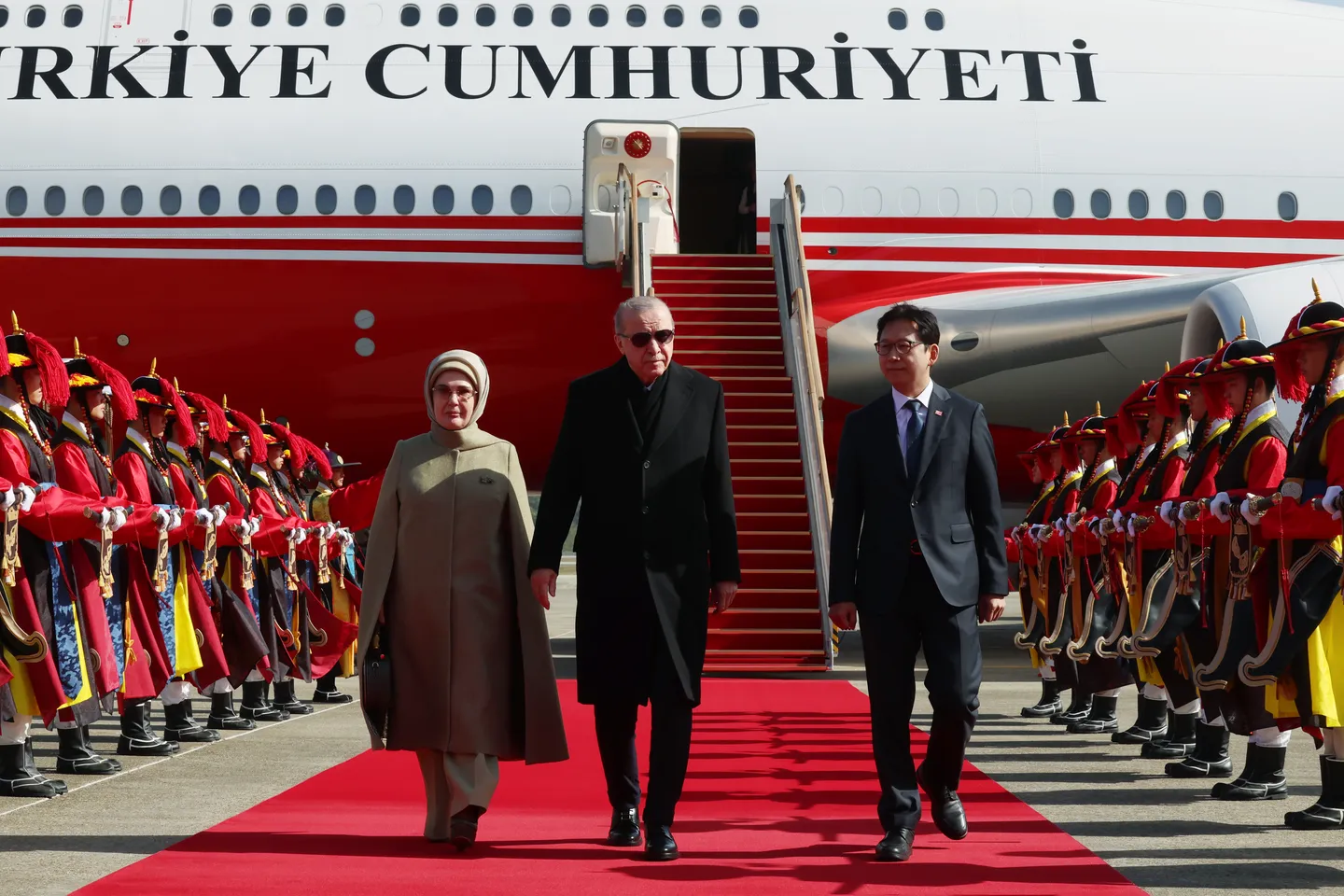
Turkish President Recep Tayyip Erdogan arrived in Seoul on Monday for an official visit aimed at strengthening Türkiye's strategic partnership with South Korea, according to TRT World. He was welcomed at Seoul Air Base in Seongnam by South Korean Trade Minister Park Jung-sung, alongside Türkiye's ambassador to South Korea, Fatih Yildiz, and his wife, Nesrin Yildiz. The visit comes at the invitation of President Lee Jae-myung and is scheduled to run until 4 November.
The substantive business begins on Tuesday, when the two leaders are due to hold official talks covering what the report describes as all aspects of the strategic partnership, as well as current regional and international developments. The two sides are also expected to sign several agreements intended to strengthen the legal framework governing bilateral relations. The report does not specify which agreements are planned, nor which regional or international issues will be discussed.
The composition of the Turkish delegation is the clearest signal of where Ankara sees the weight of the relationship. Erdogan is accompanied by Foreign Minister Hakan Fidan, Energy and Natural Resources Minister Alparslan Bayraktar and Defence Minister Yasar Guler. Industry and Technology Minister Mehmet Fatih Kacir, AK Party deputy chair Halit Yerebakan, who oversees the party's health policies, and Defence Industries Secretary Haluk Gorgun are also travelling. The presence of both the defence minister and the head of the defence industries agency points to arms procurement and co-production as a likely area of discussion, though the report does not confirm this.
For Seoul, the visit offers a chance to deepen ties with a NATO member that sits at the junction of Europe, the Middle East and Central Asia, and which has become a significant supplier of defence equipment in recent years. For Ankara, South Korea represents a source of technology and industrial partnership as well as a like-minded partner on export-led manufacturing. The report frames the visit as an opportunity for both countries to review existing cooperation and explore ways to expand their strategic partnership, without giving further detail.
What is not yet known is the substance of what will be signed. The report gives no figures on trade, no details of defence contracts and no indication of whether the talks will produce a joint declaration. Nor is it clear how far the discussions will touch on security questions beyond the bilateral agenda. Those details should become clearer after Tuesday's talks, and until then the visit is best read as a diplomatic opening rather than a settled outcome.
The broader significance lies in timing. Türkiye has spent recent years diversifying its partnerships beyond its traditional Western alliances, while South Korea has sought to expand its diplomatic and commercial reach. A visit framed around a strategic partnership, backed by a delegation heavy with defence and energy figures, suggests both governments see room to deepen the relationship. Whether that translates into concrete agreements will be the measure of the visit.