What the material does show is a landscape that served successive rulers over more than five centuries.
Archaeologists working in Beijing have uncovered the first confirmed remains of a Sui dynasty section of the Great Wall in the Chinese capital, according to a report in the Times of India. The find was made at the Dalinggou site in Changping district, where excavation ran from August to October 2026 across roughly 800 square metres. The same announcement included three wooden boats, about 1,800 years old, found buried some seven metres underground in an old river channel in Fengtai district.
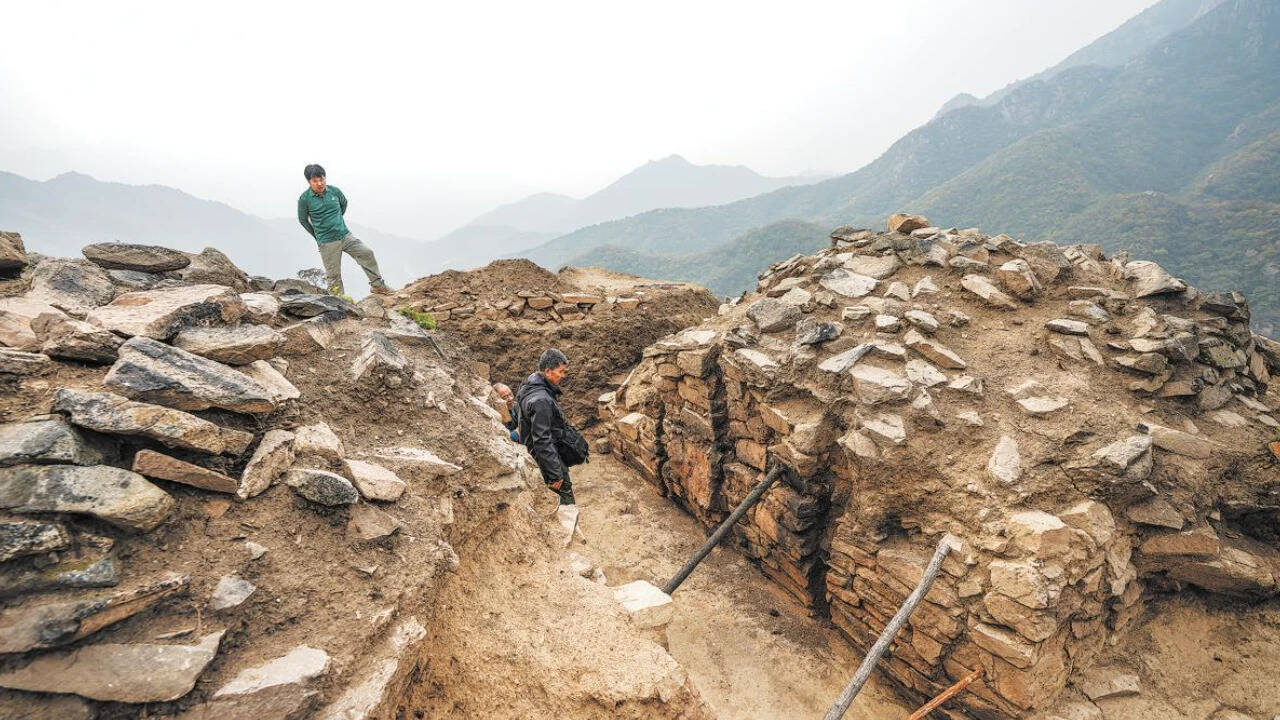
The wall remains take the form of a military outpost built against an early section of the fortification, with its northern wall incorporated into the existing structure and traces of buildings and retaining walls inside the enclosure. The walls were made largely from roughly hewn stones bound and filled with loess, an earth-and-stone core quite unlike the polished brickwork of the much later Ming wall. More than 60 artefacts were recovered, including pottery, porcelain, metal objects, architectural components, everyday items and weapons, suggesting a working installation where soldiers, builders and support staff lived and stored equipment.
The dating rests on two objects in particular: a Sui-era wuzhu bronze cash coin and a piece of porcelain closely resembling known Sui ceramics. Before the excavation, Dalinggou had been classified as part of the Northern Qi wall, built between 550 and 577. The new evidence indicates the fortification was also used under the Sui, who ruled from 581 to 618, and that parts remained in service as late as the Jin dynasty, from 1115 to 1234. "This is the first discovery of Sui Dynasty Great Wall remains in the Beijing area," Shang Heng of the Beijing Institute of Archaeology said, adding that it would help study the age, location, direction and defence system of the early wall and may assist in tracing Sui sections in neighbouring Hebei and Shanxi.
The find fits a wider pattern. Dalinggou lies along the same defensive line as previously identified Sui remains: an inscription in Kelan County, Shanxi, records construction in 599; another from 597 was found in Luanping County, Hebei; and a Sui beacon tower has been identified in Qianxi County. Together these point to a broad frontier network rather than isolated local works, and the Beijing site may help scholars map the early wall's route and the organisation of military authority across northern China.
The boats, named Yongding River No. 1, No. 2 and No. 3, date to roughly 1,800 years ago, during the Han and Jin dynasties, and are described as the largest and most structurally complete inland waterway vessels of their period found in northern China. One bears the character guan, meaning official, which may indicate government construction or operation. Their beams, bottom supports, vertical braces and partition boards show considerable shipbuilding skill. Wooden objects, woven matting and human remains were found with the vessels, and animal bones nearby; researchers offer a preliminary interpretation that the boats were damaged and gathered at a river bend for repair before a sudden flood buried them.
What the discoveries do not yet establish is how extensive the Sui occupation of the outpost was, how the garrison was supplied, or whether the boats were indeed undergoing repair when the flood came. Those readings remain provisional pending fuller publication of the excavation. What the material does show is a landscape that served successive rulers over more than five centuries, and a capital whose history as a fortified frontier and as a river-borne trading hub predates its modern form by a considerable margin.