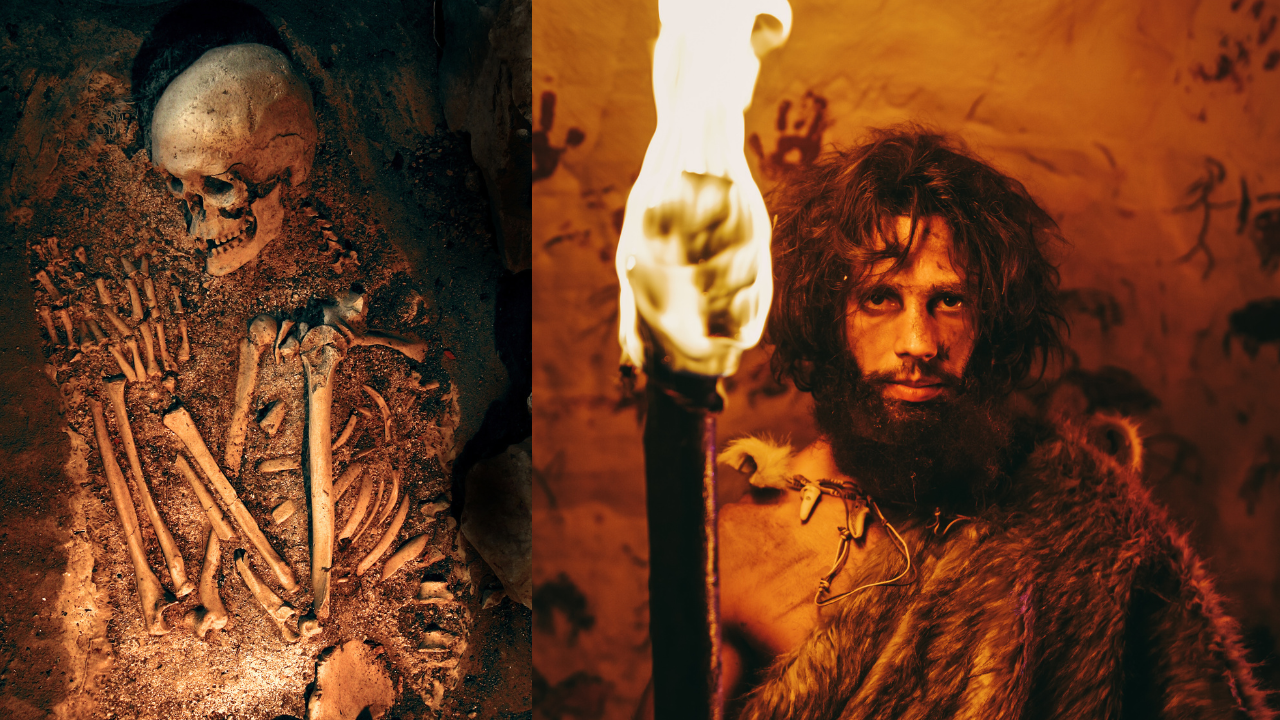
The same skeleton therefore carries evidence of both lethal injury and sustained support within a group.
Researchers from the University of Cambridge have described a 75,000-year-old Neanderthal skeleton bearing a small, circular hole in its left shoulder blade, according to a study published in the journal Scientific Reports and reported by the Times of India. The remains, designated Shanidar A, were recovered from Shanidar Cave in Iraqi Kurdistan. The injury, the researchers suggest, is consistent with a sharpened wooden spear passing through the chest, possibly in an attack deliberately aimed at the heart.
The condition of the scapula is what makes the find notable. The bone is delicate, with sections thin enough to admit light, yet it survived roughly 75,000 years beneath some 7.5 metres of rock and sediment almost intact. The principal damage is a near-circular opening about 15 millimetres across. Spears tipped with flint or stone tend to leave flatter or more angular openings, whereas the rounded shape of this injury is consistent with a sharpened wooden point.
From the position of small fragments of bone displaced on impact, and the bevelled edges around the opening, the team reconstructed the path of the weapon. In their account the spear entered the front of the left chest, passed through a lung and probably major blood vessels, and pierced the shoulder blade from behind, travelling downwards from above. The force and placement, they suggest, could have produced a rapidly fatal wound.
The study does not establish what happened. The authors acknowledge that the injury could reflect an attack by another Neanderthal, or an accident during hunting. Neanderthals hunted large and dangerous animals, sometimes at close range with thrusting spears, and Dr Emma Pomeroy, the lead author from Cambridge's Department of Archaeology, conceded that hunting animals such as mammoths could have produced similar injuries. The distinction between a killing and a hunting death is not one the bone can settle on its own.
The remains also point in another direction. Shanidar A's teeth show an earlier severe facial injury that damaged a front tooth and pushed neighbouring teeth inward, and the individual appears to have survived it for at least a year, possibly longer. Such damage would have made eating difficult, and Pomeroy suggests that survival would likely have required some form of care from others, perhaps through softer foods. The same skeleton therefore carries evidence of both lethal injury and sustained support within a group.
What is not yet known is whether the wound was inflicted deliberately, by whom, and under what circumstances. The researchers describe the find as potentially the oldest known evidence of fatal interpersonal violence involving a wooden spear in the hominin fossil record, a claim that rests on reconstruction rather than direct proof of intent. The wider significance is that the debate over Neanderthal violence and Neanderthal care now runs through a single, unusually well-preserved bone.