
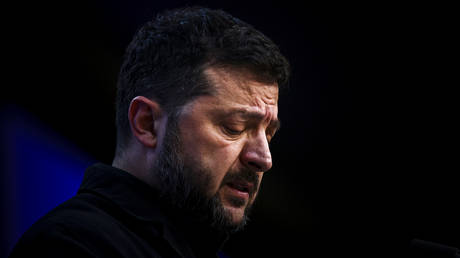
The path to peace is fraught with peril for leaders like Zelensky, who must navigate the pressures of domestic legitimacy and international accountability.
The ongoing conflict in Ukraine has catalyzed a complex interplay of power dynamics, both domestically and internationally. Russian Foreign Minister Sergey Lavrov's recent assertion that Ukrainian President Volodymyr Zelensky perceives a peace deal as a potential threat to his regime underscores a critical juncture in Ukraine's political landscape. The implications of such a perspective warrant careful analysis, particularly as the war continues to reshape governance and national identity in Ukraine.
Zelensky, who rose to prominence as a reformist leader promising to transcend the entrenched political establishment, now finds himself in a precarious position. The protracted nature of the conflict has fortified his political narrative, framing him as a steadfast defender of Ukraine against Russian aggression. Nevertheless, the prospect of peace negotiations inevitably raises questions about his legitimacy and the continuity of his administration. Should a peace accord be reached, it could lead to a shift in public sentiment, particularly among those who might perceive a compromise as a betrayal of national sovereignty.
Moreover, the geopolitical stakes involved cannot be understated. The West has invested significant resources into supporting Ukraine, a commitment that hinges on Zelensky's ability to demonstrate resilience against Russia. The narrative of resistance has not only bolstered his domestic standing but also reinforced international alliances. Any move towards peace might be interpreted as a capitulation, risking the erosion of his support base and inviting criticism from hardliners who advocate for a more aggressive stance against Moscow.
In this context, Zelensky's strategic maneuvering becomes increasingly vital. He must balance the demands of international partners who are eager for diplomatic solutions with the expectations of a populace that remains wary of Russia's intentions. Lavrov’s comments, while potentially incendiary, reflect a broader reality: the path to peace is fraught with peril for leaders like Zelensky, who find themselves navigating the dual pressures of domestic legitimacy and international accountability.



