
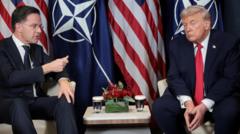
Trump’s remarks serve as a litmus test for the current geopolitical climate, potentially altering U.S. engagement in European security matters.
In a recent series of remarks, former President Donald Trump has reignited discussions surrounding NATO, casting a critical eye on the alliance's strategic direction and its financial commitments. This critique comes at a time when NATO Secretary-General Jens Stoltenberg has characterized a recent meeting of alliance members as 'very frank,' a term that implies both honesty and potential discord within the ranks.
Trump's perspective on NATO has been consistent since his presidency, emphasizing a transactional view of international alliances that prioritizes national expenditure over collective security. His assertion that allies should contribute more to defense budgets echoes sentiments that have gained traction among certain factions within the Republican Party. This perspective raises essential questions about the future viability of NATO as a collective security arrangement and highlights the evolving nature of U.S. foreign policy priorities.
From a strategic standpoint, Trump’s remarks serve as a litmus test for the current geopolitical climate. The alliance, which has historically been a cornerstone of Western security architecture, is facing challenges not only from within its membership but also from external threats, particularly from Russia and China. As NATO grapples with these complexities, the implications of Trump’s critique cannot be understated. His ability to galvanize support for a more isolationist approach could significantly alter the dynamics of U.S. engagement in European security matters.
Furthermore, Stoltenberg's characterization of the NATO meeting as 'very frank' suggests an acknowledgment of the deep-seated concerns among member states regarding burden-sharing, strategic priorities, and the need for unity in the face of external aggression. As NATO continues to adapt to a changing security landscape, it is imperative for the alliance to engage in candid discussions that reflect both the aspirations and apprehensions of its members.
As the 2024 presidential election looms, the dialogue surrounding NATO will likely evolve, influenced by broader debates on U.S. foreign policy. For NATO to maintain its relevance, it must navigate the minefield of political rhetoric while reaffirming its commitment to collective defense. The stakes are high, not only for the alliance itself but for global stability as a whole.



