
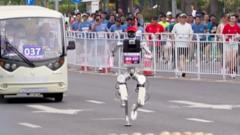
This event not only highlighted the remarkable advancements in artificial intelligence and robotics but also served as a litmus test for society’s evolving relationship with technology in competitive sports.
In an era where the integration of technology into daily life is ubiquitous, the recent half marathon in China showcased a profound and symbolic confrontation between human athletes and their robotic counterparts. This event not only highlighted the remarkable advancements in artificial intelligence and robotics but also served as a litmus test for society’s evolving relationship with technology in competitive sports.
The participation of robots in what is traditionally a human-centered event raises critical questions about the essence of competition and the future of athleticism. While human runners embody resilience, endurance, and emotional drive, robots represent precision, speed, and efficiency. This juxtaposition invites us to ponder not just who crosses the finish line first, but what it means for humanity when machines can replicate or even surpass human capabilities in areas that were once the exclusive domain of athletes.
Moreover, this event can be viewed within the broader context of the ongoing discourse surrounding automation and its implications for various sectors. As robots increasingly take on roles that require physical prowess, the implications for labor, ethics, and societal values become increasingly pronounced. Are we witnessing the dawn of a new era where machines not only augment human capabilities but compete directly against us? And if so, how do we reconcile our cultural reverence for human achievement with the efficiency of machines?
While the spectacle of runners versus robots brought excitement to spectators, it also underscores a pressing need for policymakers, educators, and technologists to engage in meaningful dialogue about the future of work and athletic competition. The implications of this event extend far beyond the racecourse; they touch upon issues of identity, competition, and the fundamental nature of progress. As we stand at this technological crossroads, it is imperative that we consider not just the capabilities of machines but also the values we wish to uphold in a world increasingly defined by automation.



