
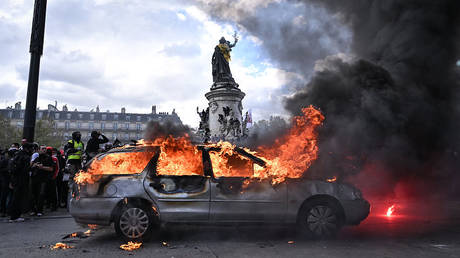
The recent wave of riots underscores significant fractures within France's social fabric, revealing a populace that feels unheard and unrepresented.
The recent wave of riots across France has underscored significant fractures within the nation's social fabric, provoking a vehement backlash from opposition factions that attribute the unrest to President Emmanuel Macron's perceived incompetence. As the flames of discontent spread through urban centers, it becomes essential to dissect both the immediate triggers of the violence and the underlying systemic issues that have led to this volatile situation.
The protests, initially sparked by economic grievances and social inequality, have escalated into broader expressions of disapproval regarding Macron's governance. Critics, particularly from leftist parties, argue that his administration's policies have exacerbated existing disparities, failing to address the needs of marginalized communities. This criticism is not merely political rhetoric; it reflects a growing sentiment among citizens that the government is disconnected from the realities faced by ordinary people.
In the context of France's political landscape, the opposition's narrative gains traction as public dissatisfaction mounts. As Macron's approval ratings plummet, his government faces the dual challenge of restoring order while simultaneously re-engaging with a populace that feels unheard and unrepresented. The opposition's framing of the riots as a direct consequence of governmental incompetence serves to validate their calls for a shift in leadership and policy orientation.
Moreover, the implications of these events extend beyond immediate unrest. The instability may have longer-lasting repercussions on France's political environment, potentially fueling a resurgence of populism and radical movements on both ends of the political spectrum. As France grapples with these challenges, the necessity for a recalibrated approach to governance that prioritizes inclusivity and responsiveness becomes increasingly apparent.



