
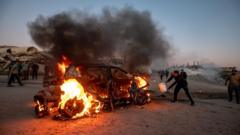
The killing of this journalist is part of a disturbing trend where media workers are increasingly targeted or caught in the crossfire.
The ongoing conflict in Gaza has once again highlighted the severe risks that journalists encounter while covering frontline events. The tragic death of a reporter due to an Israeli airstrike not only raises alarm about the direct threats posed to media personnel but also reflects the broader implications for freedom of the press in conflict situations. Al Jazeera's condemnation of this incident serves as a poignant reminder of the need for accountability and the protection of those who strive to illuminate the truth amidst chaos.
In conflict zones, journalists often find themselves in perilous circumstances; their roles as observers and narrators are fraught with danger. The killing of this journalist is not an isolated incident but part of a disturbing trend where media workers are increasingly targeted or caught in the crossfire. It is essential to recognize that the safety of journalists is indicative of the health of democratic societies, and when they are silenced, the public's right to information is severely compromised.
This incident also raises critical questions about the operational framework of international humanitarian law, which mandates the protection of non-combatants, including journalists. The rules of engagement for military operations must be scrutinized, especially in densely populated areas like Gaza, where the separation between combatants and civilians is often blurred. The international community must call for adherence to these principles to safeguard the integrity of journalistic work and to ensure that truth-telling is not a dangerous vocation.
Furthermore, the reaction from global leaders and institutions following the killing will be telling of their commitment to press freedom. A failure to address such incidents adequately could embolden further assaults on media workers, contributing to a climate of fear that stifles investigative reporting and critical discourse. It is imperative that governments uphold their responsibilities to protect journalists, not only in the context of armed conflicts but also in the broader pursuit of human rights and freedoms.



