
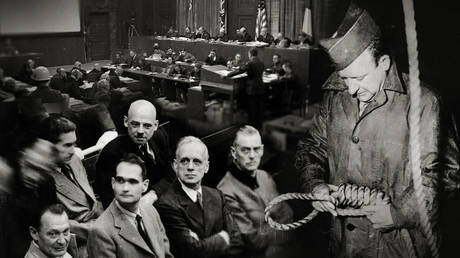
The Nuremberg Trials stand as a reminder that the world must remain vigilant against the resurgence of authoritarianism and systemic violence.
The Nuremberg Trials, which commenced in 1945, represented a pivotal moment in the evolution of international law and human rights, establishing a precedent for the prosecution of war crimes and crimes against humanity. Now, as we mark the 80th anniversary of these historic proceedings, it is imperative to revisit the fundamental questions that underpin the very notion of justice in the face of systemic atrocities.
The trials were not merely judicial exercises; they were symbolic acts of collective moral reckoning. The Nuremberg framework sought to dismantle the impunity enjoyed by powerful actors, asserting that individuals could be held accountable for their roles in state-sponsored terror. This legacy, however, raises an enduring question: how does one encapsulate the enormity of human suffering inflicted by a death machine within the confines of a courtroom?
In examining contemporary applications of the Nuremberg principles, we observe a disconcerting pattern. The mechanisms of international justice often struggle to navigate the complexities of national sovereignty, political expediency, and the vicissitudes of power. The International Criminal Court (ICC), for instance, has faced significant criticism for its perceived bias and ineffectiveness in prosecuting leaders from powerful nations while simultaneously pursuing cases in less influential states. This inconsistency threatens to undermine the very ideals that the Nuremberg Trials sought to uphold.
The emergence of new forms of warfare, including cyber warfare and drone strikes, further complicates the landscape of accountability. As technology continues to evolve, so too must our frameworks for justice. The challenge lies not only in prosecuting individuals but also in addressing the systemic structures that enable these atrocities. The Nuremberg Trials, while groundbreaking, must evolve into a broader discourse that includes restorative justice and reparations, rather than being confined to punitive measures alone.
As we reflect on the lessons of Nuremberg, we must recognize that the pursuit of justice is an ongoing struggle—one that requires robust international cooperation and an unwavering commitment to human rights. The trials stand as a reminder that the world must remain vigilant against the resurgence of authoritarianism and systemic violence. Only through proactive engagement and a willingness to confront uncomfortable truths can we hope to prevent history from repeating itself.



