
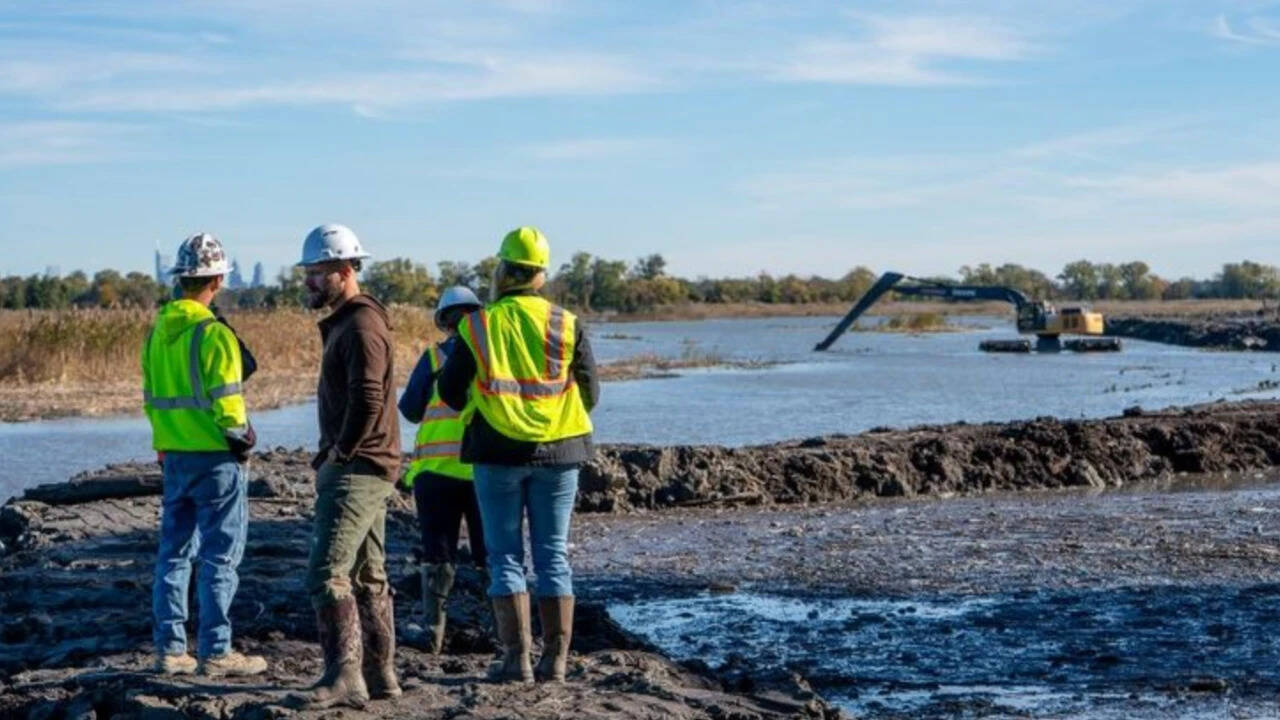
The work is a response to decades of damage: historic land filling, dredging and the construction of dikes have restricted the tidal flows on which the marsh depends.
At Henderson Marsh, inside the John Heinz National Wildlife Refuge at Tinicum in Philadelphia, conservationists have begun excavating close to 13,000 linear feet of tidal channels to reconnect a degraded freshwater marsh with Darby Creek. According to Ducks Unlimited, which reported the project on 10 November 2026, the aim is to restore nearly 150 acres of freshwater tidal marsh and to let water move through the wetland more naturally. The work is a response to decades of damage: historic land filling, dredging and the construction of dikes have restricted the tidal flows on which the marsh depends.
The setting gives the project its weight. Established in 1972, the refuge is recognised as the first urban national wildlife refuge in the United States and protects the largest remaining freshwater tidal marsh in Pennsylvania, sitting close to Philadelphia International Airport in a landscape otherwise heavily developed. Rather than adding vegetation or building artificial habitat, the project focuses on reopening the channels through which water enters and crosses the marsh, with additional connections to Darby Creek expected to improve tidal circulation overall.
Conservationists expect the restored hydrology to benefit American black ducks, mallards, shorebirds, wading birds, American shad and American eels, among other species. The channels should give fish better passage between the creek and the marsh, while the wetland offers birds feeding and resting grounds. Plans also include tidal pools and other features intended to support a wider range of aquatic and wetland species.
The benefits are not expected to stop at the refuge boundary. Communities around the Lower Darby Creek watershed, including Philadelphia's Eastwick neighbourhood and nearby Tinicum Township, have suffered repeated flooding from Darby and Cobbs creeks, and during Hurricane Isaias in August 2020 floodwaters overtopped dikes and damaged sections of the refuge. The restoration is presented as part of a wider effort to explore nature-based approaches to flood resilience. It is not being sold as a standalone solution to flooding, and readers should treat claims of reduced flood risk to homes as an aspiration rather than a demonstrated outcome.
The work is a partnership involving Ducks Unlimited, the U.S. Fish and Wildlife Service, the National Oceanic and Atmospheric Administration and other federal, state and local conservation partners, with Michels Construction undertaking the excavation and dredging. According to the U.S. Fish and Wildlife Service, construction began in September 2026 and is expected to take around 12 to 18 months. The project also includes a new kayak and canoe launch, an observation tower overlooking the marsh and new signage along the trails.
What is not yet known is how quickly the marsh will respond, how much the restored channels will alter flood behaviour in Eastwick and Tinicum during major storms, and what the project will cost. The reported timeline and species list come from the partners promoting the scheme; independent monitoring of the results will be the test of whether reconnecting a creek to a city marsh delivers on both its ecological and its civic promises.



