The finding of continuous transmission, rather than any single outbreak, is what removed the designation.
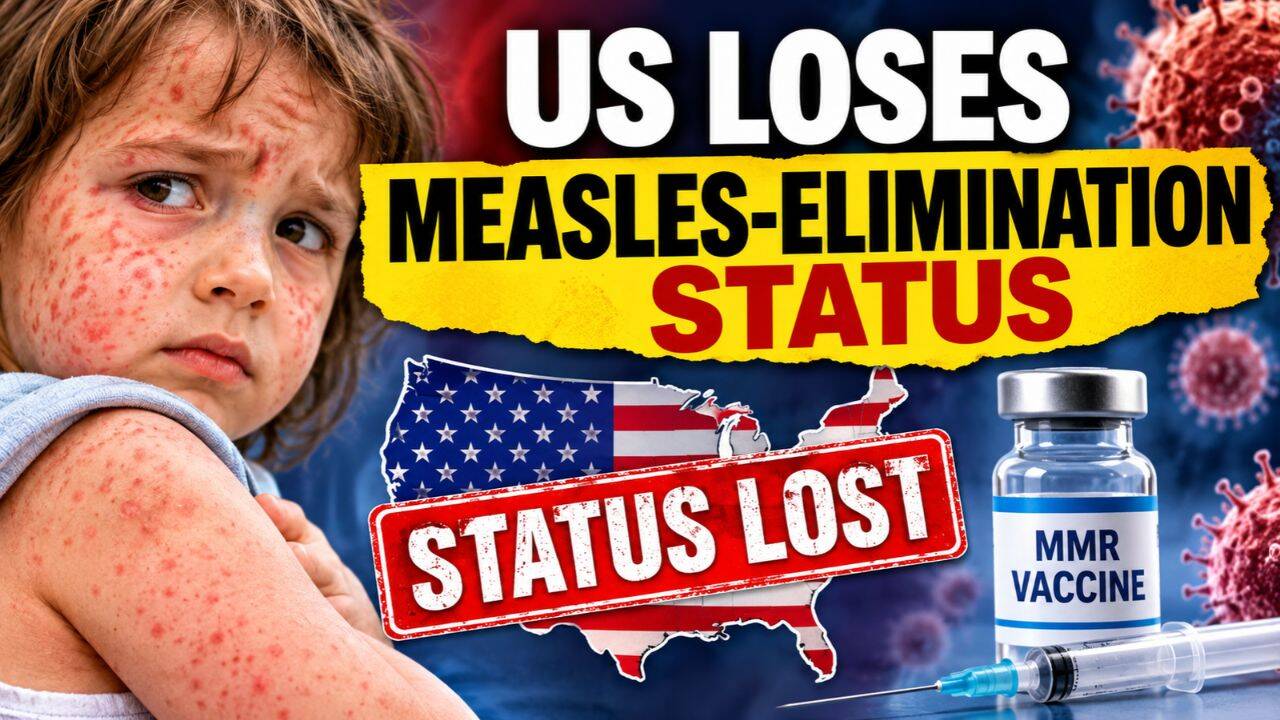
The United States has lost its measles-elimination status, according to the Times of India, which reports that an independent commission of the Pan American Health Organization voted to withdraw the designation after concluding that measles transmission had continued uninterrupted in the country for more than twelve months. The US was declared to have eliminated the disease in 2000. PAHO, which operates under the World Health Organization, is expected to announce the decision formally on Tuesday.
The figures behind the ruling are stark. More than 5,400 measles cases have been reported in the US this year, more than twice the previous year's total and the highest annual count since 1991, according to the report. State health departments have reported ten deaths. Noel Brewer, a public health professor at the University of North Carolina at Chapel Hill, told the paper that the country had recorded more measles cases in the last eighteen months than in the previous twenty-five years combined.
The commission's method matters as much as its verdict. Its eight-member panel of public health experts met in Washington for four days last week, analysing genetic information from locally acquired infections to establish whether outbreaks in different states were connected. It also weighed vaccination coverage, the effectiveness of surveillance systems and the country's readiness to contain outbreaks. The finding of continuous transmission, rather than any single outbreak, is what removed the designation.
Vaccination coverage has slipped across the country. Only 92 per cent of kindergarten children had received the vaccine in the 2025-26 school year, against 95 per cent in 2019-20, the level generally considered necessary to prevent outbreaks. An NBC News investigation found coverage below that benchmark in 75 per cent of US counties and jurisdictions for which data were available. In three rural counties — Catron in New Mexico and Adams and Custer in Idaho — kindergarten coverage has fallen below 50 per cent. Walter Orenstein, former director of the US Immunization Program at the CDC, warned that unvaccinated people face considerable risk, with infants and the immunocompromised especially vulnerable. At least four of this year's deaths involved infants too young for the routine vaccine.
The political context is unavoidable. Health Secretary Robert F Kennedy Jr has questioned the safety and effectiveness of measles vaccines, and President Donald Trump suggested in August that the combined vaccine could be "quite lethal", despite decades of evidence supporting its safety. A health department spokesperson said the CDC had provided an additional $100 million in October and sent specialists to assist states, and that Kennedy and CDC Director Dr Erica Schwartz continue to recommend the MMR vaccine. Brewer argued that repeated public questioning of vaccination had undermined parental confidence. The report also notes that the CDC has not held the briefings and vaccination drives it mounted in previous administrations.
Restoring the designation could take several years, public health experts believe. Canada lost its own status last year after an outbreak of more than 5,000 infections, and Jon Andrus, who chairs the PAHO commission, said Canada had made significant efforts and shown political commitment at the highest level. Whether Washington mounts a comparable campaign is not yet clear; nor is the full scope of the outbreaks behind the decision, beyond the case and death totals reported.