The business model has diversified to answer the problem of a short selling window.
A fourteen-year-old from Norwich has built a small horticultural business out of a family gardening competition, according to a report by the BBC. Jacob Mann, who trades as The Tomato Cart, now cultivates up to 7,000 tomato plants a year and sells growing kits and tomato-themed merchandise to customers well beyond his home city, with buyers reported as far away as Australia.
The origins are modest. During the Covid pandemic his family turned its vegetable patch into a friendly competition, and his plot flourished while others struggled. That experience, described in a case study published by The Shropshire Seaweed Company, encouraged him to take growing seriously and to think about running his own garden centre one day. The commercial prompt came later, when his brother began earning money from a paper round and Jacob wanted an independent income of his own. Tomatoes appealed because they were enjoyable to grow and could eventually be eaten.
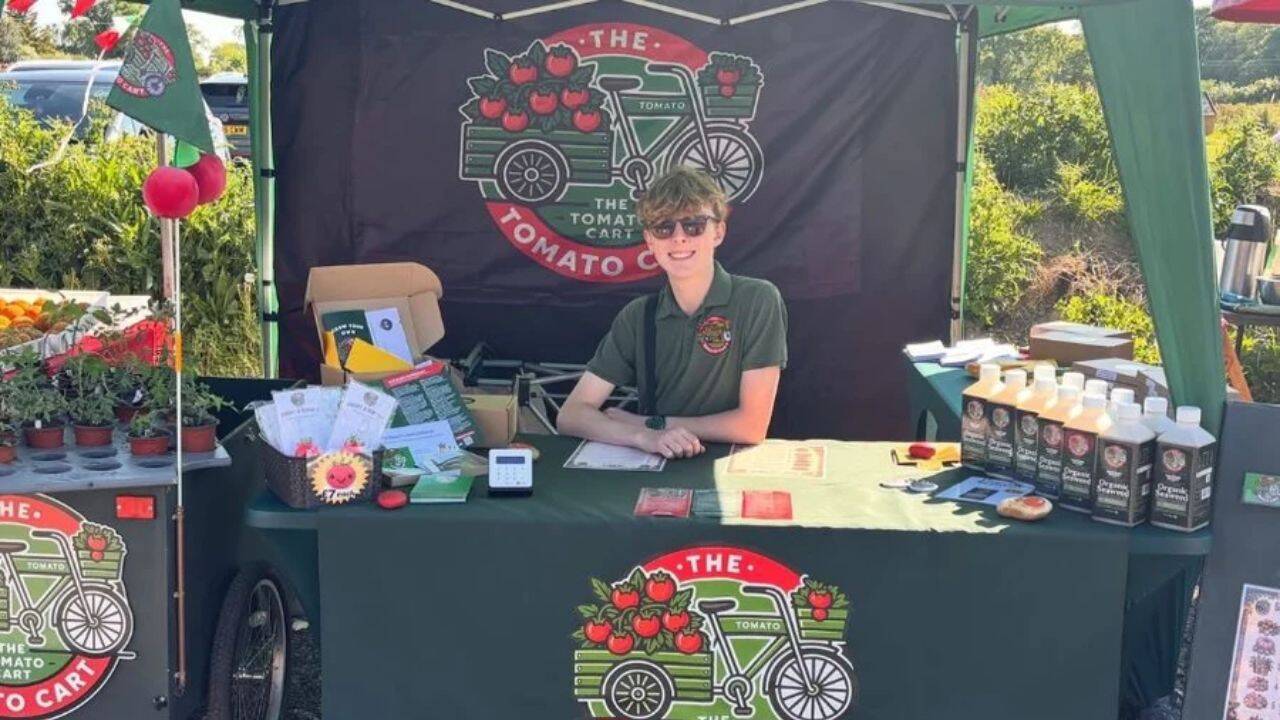
The infrastructure followed cheaply. He found a greenhouse through Freecycle with his father two days before his thirteenth birthday in December 2024, and saved pocket money to buy an old trailer base through Gumtree. Father and son converted it into a cart that attaches to a bicycle and can be taken to local markets and car boot sales. The BBC reported in March 2026 that he had initially sold around fourteen plants before demand rose sharply; the greenhouse now holds as many as 7,000. He waters before school, and his parents help ensure the business does not interfere with his education, according to the Shropshire Seaweed Company.
The constraints are those of any seasonal grower, sharpened by youth. British weather, from freezing nights to heatwaves, has made large-scale cultivation difficult; before installing greenhouse heaters he sometimes brought plants indoors overnight. Selling at markets brought a different worry, that customers might not take him seriously because of his age, and he was initially uncomfortable explaining his products or appearing in social media videos. He has since appeared on podcasts, in local newspapers and on radio, and attended the RHS Sandringham Flower Show, where he met the gardening personalities Rekha Mistry, Ade Sellars and Alan Titchmarsh.
The business model has diversified to answer the problem of a short selling window. Alongside plants sold at markets, online and through his own website, The Tomato Cart advertises home growing kits through Etsy, containing seeds, compost, labels, pots and instructions written by Jacob, as well as a pizza-growing kit with San Marzano tomato, basil and oregano seeds. A line of crocheted tomato keyrings sold with adoption cards, under the name Adopt a Tomato, keeps something on sale when the greenhouse is bare. The BBC reported that an Australian customer bought one of the crocheted mascots from roughly 10,000 miles away.
What is not established is the scale of the operation in financial terms. No revenue, costs or profit figures are given, and the 7,000-plant figure is a capacity reported by the BBC rather than an audited output. The international sales described are individual purchases rather than a distribution network. What the case does show is how low-cost second-hand equipment, a bicycle and an online shopfront can extend a local seasonal trade into something wider, and how a young grower is using merchandise to smooth the months when nothing is ready to sell.