
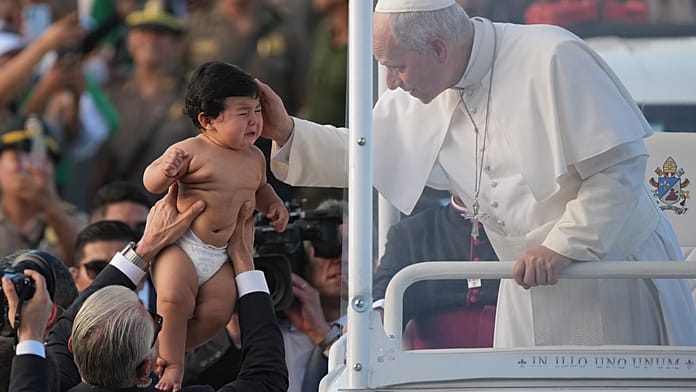
The scene captures something worth noting about the politics of a papal tour.
Crowds lined the streets of Lima on Sunday, 15 November, as the revered Lord of Miracles icon was carried by truck to Las Palmas Air Base, according to Euronews. Pope Leo XIV was due to celebrate Mass there the following day. Worshippers waved papal flags and held portraits of the pontiff as the procession moved through the Peruvian capital.
The report describes one woman scattering flower petals as the icon passed. The Lord of Miracles is among Peru's most cherished religious symbols, and its presence was set to mark the largest gathering of the Pope's visit to the country, on the final day of his 12-day Latin American tour.
Outside the air base, hundreds of Catholics had already begun queuing, prepared to spend the night waiting for a chance to get close to the Pope. Some sang and prayed, while others shared food they had brought with them. Street vendors sold rosaries, T-shirts, portraits and even plush toys depicting Leo XIV. Volunteers entered the air base to prepare for Monday's Mass.
The scene captures something worth noting about the politics of a papal tour. A visit of this length across Latin America is, in part, a statement of institutional priority. The overnight vigil outside a military air base, with vendors trading in plush likenesses of the pontiff, shows how thoroughly the visit has been absorbed into ordinary civic life in Lima. Devotees quoted in the report described the wait as a sacrifice worth making, and some expressed hopes that the visit would bring peace and unity.
Those hopes are, by their nature, difficult to measure. The report does not say what the Pope said at the Mass, what themes he has pressed during the tour, or how the Peruvian government has engaged with the visit. It gives no attendance figures for the Mass itself, only that the gathering was expected to be the largest of the trip. It does not indicate whether the overnight queue outside the base passed without incident, nor how the authorities managed the crowds.
What is confirmed is the choreography of the final day: the icon's journey through Lima, the flags and portraits, the vigil, and the volunteers preparing the site. For a pontiff closing a 12-day regional tour, the imagery of a national devotion carried to the threshold of a Mass carries its own message, whatever is said from the altar. The substance of that message will emerge only once the Mass has taken place and its content is reported.



