
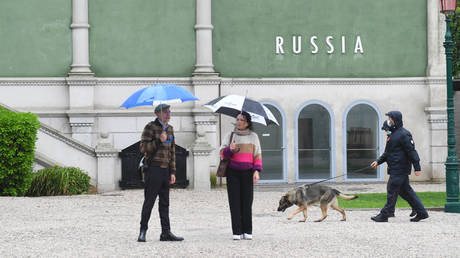
The Venice Biennale's jury resignation signals a clear message: art cannot be dissociated from the political contexts in which it exists.
The recent resignation of the jury at the Venice Biennale, a prestigious international art exhibition, underscores a growing tension between cultural institutions and geopolitical realities. The jurors cited ongoing International Criminal Court (ICC) cases against Russia and Israel as their rationale for stepping down, illustrating how deeply intertwined the realms of art and global politics have become.
This incident is not merely a protest against specific national actions, but rather a significant statement about the role of cultural platforms in advocating for justice and accountability. The Venice Biennale, celebrated for its ability to foster cross-cultural dialogue, now finds itself at the epicenter of a contentious debate over the ethics of representation and the responsibilities of artists and curators in an increasingly polarized world.
From a geopolitical perspective, the jury's departure signals a clear message: art cannot be dissociated from the political contexts in which it exists. As nations grapple with complex issues of sovereignty, war crimes, and human rights violations, the cultural sector is compelled to respond — either through direct action or by making symbolic gestures that reflect the sentiments of a global audience. The legitimacy of cultural institutions is increasingly questioned in light of their responses (or lack thereof) to international law and ethical considerations.
Moreover, this trend raises critical questions about the future of the Venice Biennale and similar events. Will they continue to serve as platforms for artistic expression and dialogue, or will they become battlegrounds for political statements? The resignation of the jury could catalyze a re-evaluation of how cultural events engage with pressing geopolitical issues, potentially leading to a more integrated approach that sees art as a means of advocacy and social change.



